Address
SELLERSBURG, IN 47172




Renovating a home is rarely just a matter of choosing new cabinets, flooring or paint. The bigger financial decision comes much earlier: Should you renovate the entire house at once, or tackle one room at a time?
For homeowners considering a whole house renovation in Southern Indiana, that decision can have a substantial effect on the final cost. The same is true for homeowners planning interior home remodeling in Louisville, particularly when several rooms need updating or older electrical, plumbing, flooring or structural components are involved.
A room-by-room renovation can feel safer because the initial investment is smaller. You might renovate the kitchen this year, the bathroom next year and the living areas later. But repeated demolition, multiple contractor mobilisations, changing material prices and duplicated preparation work can make phased projects more expensive over time.
On the other hand, a whole-home remodel requires a larger upfront commitment. It also demands stronger planning, a realistic renovation budget, temporary disruption and careful project scheduling.
So which option actually saves more money?
The honest answer is: it depends on the house and the scope of work. A carefully planned whole-home renovation can be more cost-efficient when multiple systems and rooms need attention. A phased approach can be financially sensible when the house is fundamentally sound and the homeowner only needs targeted improvements.
Understanding the difference before work begins can prevent expensive decisions later.
The basic distinction is how the work is organised.
A whole house renovation treats the property as one connected project. Instead of looking at the kitchen, bathroom, bedrooms and living areas as completely separate jobs, the renovation team develops an overall plan for the house.
That plan may include:
Room-by-room renovation takes a different approach. One area is completed before another begins.
For example:
Year 1: Kitchen
Year 2: Primary bathroom
Year 3: Living room and flooring
Year 4: Bedrooms and hallway
Neither model is inherently better.
The key question is whether the rooms and systems are independent or whether changing one part of the house affects another.
That distinction becomes particularly important in older homes throughout Southern Indiana and the Louisville area, where a visually outdated room may also contain aging infrastructure that needs to be addressed during renovation.
One of the most common homeowner assumptions is that room-by-room renovation automatically costs less.
It can reduce the amount of money you need immediately. That is an important advantage.
However, cash flow and total project cost are not the same thing.
Imagine a homeowner renovates a kitchen and installs new flooring. Two years later, they renovate the hallway and adjoining living room. The new flooring has to be protected, transitions have to be matched and some trim may need to be removed and reinstalled.
The homeowner has effectively paid for mobilisation, protection and finishing work more than once.
A whole-home project may consolidate those costs.
There can also be savings through:
That does not mean a whole-home renovation will always have the lower price.
If your kitchen is outdated but the rest of the house is in excellent condition, renovating everything simply to achieve a “whole-home” label could create unnecessary spending.
The goal is not to make the biggest renovation possible.
The goal is to spend money where it produces the greatest long-term value.
Local housing conditions can influence how you approach renovation planning.
A home may look perfectly serviceable during a casual inspection but reveal additional requirements once walls, ceilings, floors or cabinetry are opened.
Experienced renovation planning therefore starts with the property rather than the finishes.
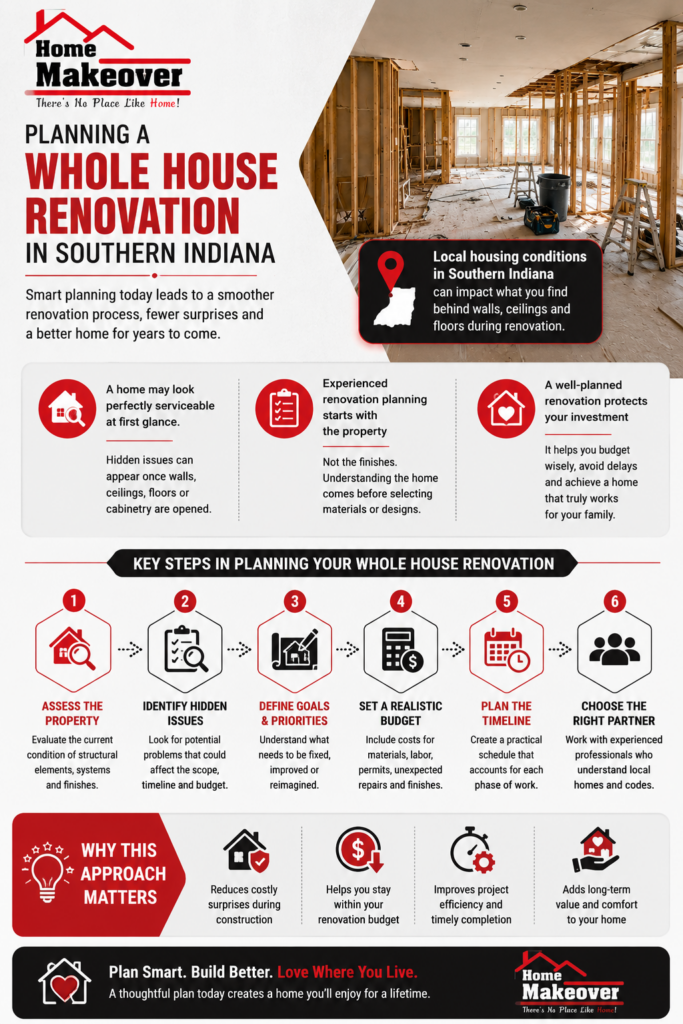
Before selecting countertops or paint colours, consider:
Identify issues involving:
Aesthetic improvements should not hide unresolved building problems.
This is where whole-home planning can become financially valuable.
Suppose you want to:
Those tasks are interconnected.
It may be inefficient to finish the kitchen completely and then return later to modify the neighbouring room.
A homeowner planning to stay for another 10 or 15 years may approach renovation differently from someone considering selling within two years.
Long-term homeowners can prioritise durability, functionality and personal comfort.
Shorter-term owners may focus more heavily on improvements that address obvious deficiencies and support marketability.
The most useful way to compare the two approaches is to look at where the money goes.
A whole-home project can offer greater efficiency when several areas require work simultaneously.
For example, if the kitchen, hallway and living room all need new flooring, doing them together may reduce duplicated labour and create a consistent finished surface.
Similarly, if an electrical upgrade affects several rooms, coordinating it during one renovation can be more efficient than repeatedly opening finished areas.
The biggest advantage is coordination.
Trades can follow a planned remodeling sequence instead of repeatedly returning to the same rooms.
Room-by-room renovation can be the better choice when:
This approach can also make family planning easier.
A family might decide to renovate the bathroom during a period when travel or school schedules make the disruption manageable, then postpone another project until later.
The downside is that every additional phase creates another round of planning and coordination.
Homeowners often budget for visible materials:
But renovation costs also come from less visible activities.
Consider:
Design and planning → demolition → preparation → rough-ins → inspections → installation → finishing → cleanup
Each stage has labour and scheduling implications.
There may also be unexpected conditions behind finished surfaces.
For example, a contractor removing old flooring may discover damaged subflooring. A wall opened for electrical work may reveal previous modifications that do not meet current requirements. A bathroom renovation may expose plumbing that needs attention before new finishes can be installed.
A responsible renovation budget should therefore include a contingency appropriate to the property’s age, condition and scope.
The exact amount should not be treated as a universal percentage. A recently updated home with a clearly defined cosmetic scope presents a different risk profile from an older property undergoing significant structural and systems work.
One of the strongest arguments for coordinated remodeling is the importance of construction order.
Renovation is not simply a collection of independent tasks.
A typical sequence might involve:
The exact sequence varies by project.
But the principle remains the same: some work must happen before other work can begin.
If flooring is installed too early, it may need expensive protection. If walls are painted before rough-in work is finished, surfaces may need to be repaired and repainted.
Good contractor efficiency comes from anticipating those dependencies rather than reacting to them.
Scheduling is another major cost consideration.
With a whole-home project, multiple trades can often be coordinated around a single master schedule.
With phased remodeling, each phase may require its own:
This does not automatically make phased work inefficient.
In fact, phased remodeling can be extremely practical when carefully planned.
The problem occurs when phases are created without considering the final renovation plan.
For instance, replacing a kitchen floor without knowing that a future wall will be removed could result in unnecessary patching or replacement.
A better approach is to create a long-term renovation map, even if the work will happen gradually.
Consider a Southern Indiana homeowner with a structurally sound home.
The kitchen cabinets are outdated, but:
There may be little financial justification for a whole-home remodel.
A focused kitchen renovation could deliver the desired improvement without disturbing functioning parts of the property.
The homeowner can then revisit other spaces when there is a genuine need.
This is an example where room-by-room renovation can protect the renovation budget.
Now consider a Louisville-area home where the homeowner wants to update the kitchen, three bathrooms, flooring, lighting and several interior walls.
The electrical and plumbing systems also need improvements.
Doing these projects separately could mean reopening finished spaces multiple times.
Instead, a coordinated project can establish one overall remodeling sequence.
Electrical work can happen before walls are closed. Plumbing can be addressed while areas are already open. Flooring can be installed across connected rooms during the same phase. Painting can follow the major construction activities.
This is where whole-home remodeling may deliver better contractor efficiency.
The initial invoice is larger, but the overall project can be more efficient because the work is treated as one connected system.
A whole-home renovation can involve substantial disruption.
Depending on scope, homeowners may need to plan around:
A room-by-room approach can reduce the immediate disruption because most of the house remains usable.
That can be a significant advantage for families.
However, the trade-off is that disruption can return every time another phase begins.
For a family with a predictable schedule, completing several related projects together may actually be easier than living through multiple smaller renovations over several years.
Before deciding, ask these questions.
If the issue is mainly paint, flooring and fixtures, room-by-room work may be appropriate.
If several systems require attention, whole-home planning deserves serious consideration.
Moving walls, plumbing or electrical components increases the importance of an overall plan.
Do not choose a whole-home renovation simply because it may be more efficient if financing it would create uncomfortable financial pressure.
Consider work schedules, children, pets, guests and temporary living arrangements.
If you already know that the kitchen will be followed by bathrooms and flooring, design those future phases into the current plan.
That can prevent costly conflicts.
Demolition can feel like progress, but opening walls before decisions are made can expose problems without giving the contractor a clear path forward.
Cabinetry, windows, tile, fixtures and specialty products may have lead times.
Delayed selections can affect the entire project scheduling process.
Electrical, plumbing, flooring and structural components often cross room boundaries.
A room-by-room mindset can overlook those connections.
The cheapest quote is not necessarily the lowest total cost.
Compare scope, allowances, materials, preparation, project management and exclusions.
Change orders are sometimes unavoidable, particularly when hidden conditions are discovered.
But frequent discretionary changes can quickly affect both cost and timeline.
Even if you cannot renovate the entire house today, understand where you ultimately want the property to go.
Address safety, water intrusion, structural concerns and failing systems before purely cosmetic improvements.
If multiple rooms need electrical, plumbing or flooring work, investigate whether completing those activities together makes financial sense.
A good remodeling sequence reduces damage to newly completed areas.
Do not allocate every dollar to finishes. Older homes can reveal conditions that were not visible during initial planning.
This is one of the most useful questions a homeowner can ask.
“If we renovate this room now, will it make the next renovation harder or more expensive?”
That single question can prevent avoidable rework.
A successful Whole House Renovation starts with careful Planning. Before work begins, homeowners should identify priority areas, establish a realistic Budget, choose materials and decide how different spaces will be completed.
Good Remodeling planning also helps prevent unnecessary rework. For example, completing connected areas together can reduce repeated preparation, labour and material costs.
A clear Timeline is equally important. Allow time for material ordering, preparation, construction and finishing rather than assuming every stage will happen immediately. Older homes may also require flexibility if unexpected conditions are discovered during renovation.
For homeowners in Southern Indiana and Louisville, the best approach is to consider the entire property before starting individual rooms. Even when renovation happens in phases, an overall plan can help each stage work toward the final result.
When comparing home renovation services in Southern Indiana, look beyond photographs of completed kitchens.
Ask potential contractors:
A professional renovation process should make these issues understandable before work begins.
Trust is built through clarity, not promises.
Not necessarily. Whole-home renovation can reduce duplicated mobilisation, demolition, preparation and coordination costs when several rooms require connected work. However, if only one or two areas need improvement, renovating the entire property could increase spending unnecessarily.
The best comparison is the total cost required to achieve the homeowner’s actual goals, not simply the size of the initial invoice.
Phased remodeling can make sense when the home is generally sound and the renovation needs are clearly separated. It is also useful when the homeowner needs to spread expenses over several years or cannot tolerate a large-scale construction disruption.
The important step is to create an overall plan first. Each phase should support the eventual finished design rather than becoming an isolated project.
There is no single contingency percentage that is appropriate for every house. A cosmetic renovation in a recently updated home has less uncertainty than a major renovation involving an older property, structural changes or concealed plumbing and electrical systems.
Ask your contractor to identify the specific risks associated with the property and scope. Then reserve funds accordingly rather than treating contingency as an arbitrary number.
It can, particularly when trades and materials can be coordinated efficiently. For example, electrical and plumbing work can be completed across several areas before walls are closed, followed by finishing activities.
However, a larger project does not automatically finish faster. Its success depends heavily on material availability, contractor coordination, inspections, design decisions and the complexity of the work.
Start with the condition of the property and your long-term goals.
If several rooms need work and the improvements are interconnected, a whole-home plan may offer better overall efficiency. If one room has a clearly defined need and the rest of the house is in good condition, room-by-room renovation may be the more sensible financial decision.
For homeowners comparing Home Remodeling vs Room-by-Room Renovation, the strongest strategy is often to think about the entire property first, even if the construction itself will happen in phases.
The cheapest renovation is not always the one with the smallest initial price tag.
A well-planned whole house renovation in Southern Indiana can make financial sense when multiple rooms, finishes and building systems need coordinated work. Similarly, interior home remodeling in Louisville can be approached room by room when the property is fundamentally sound and the scope is genuinely limited.
The deciding factors are condition, scope, budget, disruption, future plans and construction sequence.
If several renovations are already on your long-term list, develop the whole-house strategy before beginning the first phase. If only one area genuinely needs attention, there may be no reason to renovate everything.
Home Makeover Pro can help homeowners think through the scope, sequencing and practical considerations of a renovation before committing to a construction approach. The objective should always be the same: make informed decisions, avoid unnecessary rework and invest the renovation budget where it delivers lasting value.Whole Home Remodeling vs Room-by-Room Renovation in Southern Indiana & Louisville: Which Approach Saves More Money?