Address
SELLERSBURG, IN 47172




A successful home remodel rarely begins with a demolition crew. It starts with a homeowner asking a deceptively simple question: What do we actually want this house to do better?
Maybe the kitchen feels cramped. Perhaps the bathroom no longer works for a growing family. You might have an older home that needs several rooms updated at once, or you may simply want to make better use of the space you already own.
Whatever the reason, the difference between a stressful renovation and a well-managed one often comes down to what happens before construction begins.
Good home renovation planning gives you a roadmap for decisions about design, budget, materials, permits, scheduling and contractor coordination. It also helps you recognize which decisions need to happen early and which ones can wait.
For homeowners considering home remodeling in Louisville or residential home remodeling in Southern Indiana, understanding the process can make the entire experience more predictable.
This guide walks through the major stages of a remodeling project, from the first idea through the final walkthrough, with practical considerations that homeowners in the Louisville and Southern Indiana area should understand.
Before choosing cabinets, paint colors or flooring, identify the problem you are trying to solve.
A remodel should improve something specific about how your home looks, functions or performs.
For example:
This first step sounds obvious, but it is surprisingly important.
When homeowners begin with a list of products rather than a list of problems, the project can quickly become unfocused. A beautiful countertop will not solve a kitchen layout that does not work. New flooring will not correct a moisture problem underneath it.
A useful starting exercise is to divide your goals into three categories:
Must have: Improvements that solve an important functional, structural or safety issue.
Would like: Features that would improve comfort or appearance but are not essential.
Future consideration: Ideas that may make sense later but do not need to be completed during this project.
That simple distinction can protect your budget when unexpected conditions appear during construction.
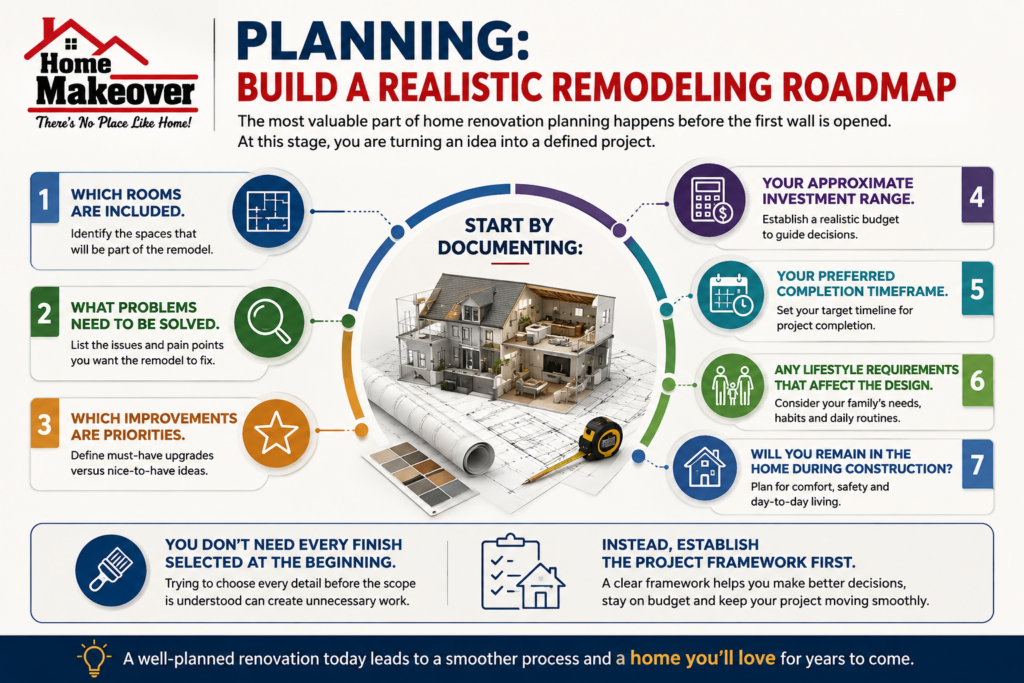
The most valuable part of home renovation planning happens before the first wall is opened.
At this stage, you are turning an idea into a defined project.
Start by documenting:
You do not need every finish selected at the beginning. In fact, trying to choose every detail before the scope is understood can create unnecessary work.
Instead, establish the project framework first.
A remodeling scope should describe the work itself rather than simply naming products.
For example, “new kitchen” is vague.
A stronger scope might include:
This gives the contractor and homeowner something concrete to discuss.
It also makes estimates easier to compare because you can determine whether different contractors are actually pricing the same work.
A remodeling consultation should be more than a sales conversation.
It should be an opportunity to evaluate the property, discuss your goals and identify practical constraints that may affect the project.
During a productive remodeling consultation, expect questions about:
A good professional should also look beyond appearances.
Depending on the project, the discussion may involve structural conditions, electrical capacity, plumbing locations, ventilation, moisture, insulation, windows, roofing interfaces or other existing components.
Imagine a homeowner wants to remove a wall between a kitchen and dining room to create a more open layout.
The visual idea may be straightforward, but the wall could contain electrical wiring, plumbing or structural support.
A qualified remodeling team should identify those possibilities early rather than treating demolition as a surprise discovery.
That is one of the practical benefits of professional consultation: the earlier potential complications are identified, the more options you usually have for addressing them.
Choosing a contractor is one of the highest-impact decisions in a renovation.
Price matters, but it should not be the only comparison point.
When evaluating a contractor for home remodeling services in Louisville, look at the overall picture:
The right contractor should be able to explain not only what will be done, but also how the work will be coordinated.
Every substantial remodeling project involves decisions and, sometimes, unforeseen conditions.
Ask prospective contractors:
The answers can tell you a great deal about how the project will operate once construction begins.
A typical renovation moves through several overlapping phases. The exact sequence varies depending on the home’s condition and project scope, but understanding the basic structure helps homeowners know what to expect.
The project begins with understanding the existing home.
This may include reviewing the layout, measuring spaces, discussing goals and identifying visible or potential issues.
For older homes, additional investigation may be particularly important because previous renovations can create hidden conditions that are not obvious from the finished surfaces.
The project is translated into plans, specifications and selections.
Depending on the project, this may include:
The more clearly these elements are defined before construction, the fewer major decisions need to be made while crews are working.
Projects requiring permits must follow the applicable local requirements.
The exact permitting process depends on the work and jurisdiction. Structural alterations, electrical work, plumbing modifications and additions can involve different requirements.
Your remodeling team should clarify which approvals are required and who is responsible for obtaining them.
This phase is also where material orders, subcontractor scheduling and site preparation become important.
Demolition is not simply “tear everything out.”
Careful demolition protects components that are staying and can reveal conditions behind walls, ceilings and floors.
For example, removing an old bathroom may reveal damaged subflooring or outdated plumbing. Discovering that condition is not necessarily evidence that the project was poorly planned; some conditions cannot be confirmed until concealed areas become accessible.
What matters is having a clear process for documenting and addressing them.
This is where much of the work that eventually becomes invisible takes place.
Depending on the project, rough construction can include:
Inspections may occur at appropriate points before walls are closed.
Once the underlying work is complete, the project begins to look like the home you envisioned.
Cabinets, countertops, flooring, tile, fixtures, trim, paint, lighting and other finish elements are installed.
This is also where prior planning pays off. If selections were finalized early and materials arrived on schedule, the finishing phase can move much more efficiently.
There is no single remodeling timeline that applies to every house.
A cosmetic update may take considerably less time than a whole-home renovation involving structural changes, multiple rooms, extensive mechanical work or custom materials.
A project timeline can be affected by:
For this reason, a responsible contractor should provide a realistic schedule rather than promising an unrealistically short completion date.
Consider a kitchen renovation where cabinets are custom-built.
If cabinet dimensions affect countertop measurements, and countertop fabrication depends on cabinet installation, a delay in the cabinets can affect multiple downstream activities.
This is why contractor coordination matters.
A remodeling project is a sequence of dependencies. One delayed activity can sometimes affect several others.
A homeowner may see different crews arrive throughout a renovation, but those crews are part of a larger sequence.
Framers may need to complete their work before electricians and plumbers can finish rough-ins. Drywall may depend on inspections. Cabinets may need to be installed before countertops can be templated.
Effective contractor coordination keeps these dependencies organized.
Home Makeover Pro, for example, can serve as the central point of coordination for homeowners who want one team managing the moving pieces of their remodeling project rather than trying to organize every trade independently.
The important principle is not simply having multiple professionals involved. It is having someone responsible for making sure their work fits together.
Local homes can vary considerably in age, construction and previous renovation history. That makes property-specific assessment important.
If you are considering a home improvement project, keep these practical points in mind.
Sometimes a small change to one room makes sense only if another space is adjusted.
For instance, moving a kitchen sink may affect plumbing. Removing a wall may affect electrical routing. Expanding a bathroom may reduce useful space elsewhere.
Think about the home as a connected system.
Even a carefully planned renovation can uncover hidden conditions.
A contingency is not an invitation to spend more. It is protection against circumstances that could not reasonably be confirmed before construction.
Your contractor can help identify where uncertainty is highest.
Cabinetry, windows, specialty fixtures and custom materials can have longer lead times than standard items.
Ask which selections are schedule-critical and make those decisions first.
If you are staying in the home, determine how construction will affect:
A good renovation plan considers the people living in the house, not just the construction drawings.
A lower estimate may reflect a narrower scope, different material allowances or omitted work.
Compare what each proposal actually includes.
Some changes are unavoidable. Others happen because decisions were not made before construction.
Repeated changes can increase costs and extend the schedule.
Renovation differs from new construction because the contractor is working with something that already exists.
Walls may not be perfectly straight. Previous work may not meet current expectations. Plumbing and electrical systems may have limitations.
Expect some investigation.
A schedule is a management tool, not a promise that nothing will ever change.
The better approach is to understand the project’s critical path and the factors that could move completion.
A successful renovation should look good, but it should also function well.
Storage, lighting, circulation, maintenance, durability and accessibility can matter just as much as finishes.
One of the most useful principles in home renovation planning is to make decisions according to their impact on the project.
A practical order is:
Function → Layout → Structural considerations → Mechanical systems → Major materials → Fixtures → Finishes → Decorative details
For example, there is little value in spending hours choosing a backsplash before you know where the cabinets, appliances and electrical outlets will be located.
Likewise, choosing paint colors before confirming flooring and cabinetry can create unnecessary rework.
The earlier a decision affects the construction sequence, the earlier it should generally be resolved.
A good remodeling plan is not rigid.
Suppose demolition reveals significant moisture damage beneath an existing floor. You may have to decide whether to repair it immediately, modify the design or adjust another part of the budget.
That is where priorities become useful.
Return to the original question: What are we trying to accomplish with this project?
If the goal is to create a durable, functional kitchen for the next decade, addressing an underlying moisture issue may be more valuable than upgrading a decorative feature.
Good remodeling decisions are not always about getting everything you initially imagined. They are about protecting the improvements that matter most.
A renovation is not finished simply because the crews have left.
The final stage should include a careful walkthrough to identify incomplete or deficient items and confirm that the project matches the agreed scope.
Depending on the project, review:
A professional final walkthrough gives both the homeowner and remodeling team an opportunity to address details before the project is considered complete.
The best remodeling experiences are rarely the result of luck.
They come from thoughtful home renovation planning, realistic budgeting, clear communication and disciplined execution.
Whether you are considering home remodeling in Louisville, a smaller renovation or residential home remodeling in Southern Indiana, the same principle applies: understand the goal first, define the scope, choose the right contractor, plan the sequence and communicate throughout the project.
Home Makeover Pro can help homeowners approach that process with greater clarity, from the initial remodeling consultation through project coordination and completion.
The goal is not simply to create a newer-looking house. It is to create a home that works better for the people who live there.
A successful remodel begins long before construction starts.
The strongest projects are built on clear goals, realistic home renovation planning, thoughtful design, qualified contractor coordination and an understanding of the major renovation phases.
If you are exploring home remodeling services in Louisville or planning residential home remodeling in Southern Indiana, take the time to build the roadmap before rushing into construction. The more clearly you understand the process, the easier it becomes to make informed decisions when the project is underway.
A well-planned renovation does more than update a house. It creates a space that better supports the way you live today—and the way you expect to live in the years ahead.
Start by identifying the specific problems you want the renovation to solve rather than immediately choosing finishes or products. Document the rooms involved, your must-have improvements, your preferred timeframe and your approximate investment range.
Then schedule a professional remodeling consultation. A contractor can evaluate the existing property, discuss feasibility and help turn your ideas into a defined scope. For larger projects, early planning can also identify structural, plumbing, electrical or permitting considerations before construction begins.
There is no universal timeline. A limited renovation may be relatively short, while a whole-home project can take considerably longer.
The remodeling timeline depends on project size, design complexity, permits, material lead times, inspections, subcontractor availability and whether unexpected conditions are discovered.
Ask your contractor for a project-specific schedule and identify which activities are on the critical path. This provides a much more useful expectation than relying on a generic “average” renovation time.
It depends on the size and location of the project.
Staying home may be practical during an isolated room renovation, but a major kitchen remodel, whole-home renovation or project involving significant dust, noise, utility interruptions or restricted access can be much more disruptive.
Before construction begins, discuss temporary kitchen or bathroom arrangements, work zones, access routes, pets, children, parking and expected utility interruptions. A good contractor should help you understand the practical impact on daily life.
You cannot eliminate every possibility, particularly when renovating an existing home, but you can reduce surprises.
Start with a detailed scope and have the contractor explain allowances, exclusions and assumptions in the estimate. Ask how change orders are handled and maintain a reasonable contingency for unknown conditions.
It is also helpful to complete major design decisions before construction begins. Late changes to layouts, cabinetry, plumbing or electrical work can be significantly more disruptive than changing a decorative finish.
Look beyond the lowest bid. Choose a contractor who can demonstrate relevant experience, provide a clear written scope, communicate effectively and explain how the project will be scheduled and coordinated.
Ask about insurance, references, permits, subcontractor management, change orders, material procurement and the final walkthrough process.
Most importantly, pay attention to how the contractor communicates during the initial consultation. A remodeling professional who listens carefully, identifies potential problems and explains trade-offs clearly is often better positioned to manage the complexities that arise during construction.