Address
SELLERSBURG, IN 47172

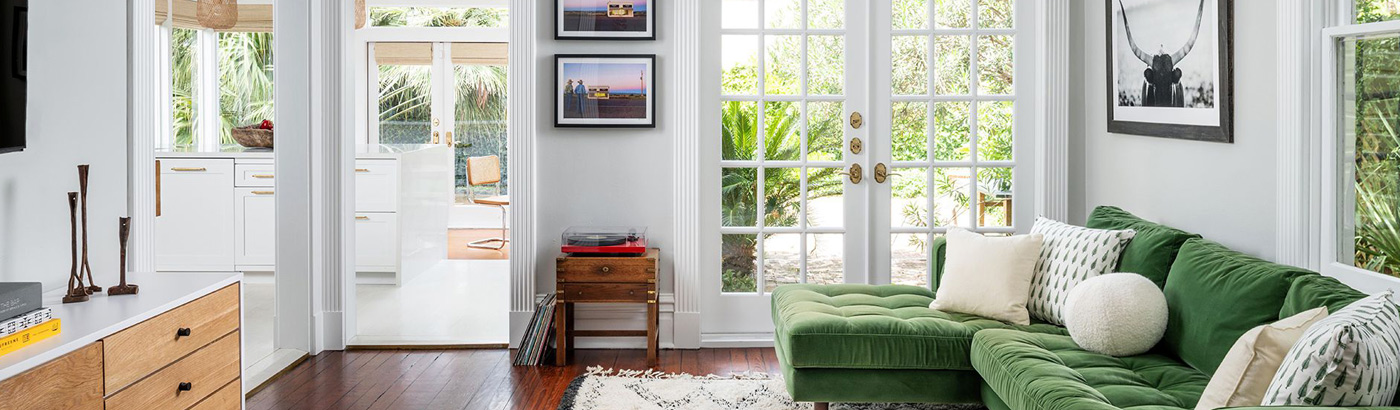
Remodeling a home is often associated with new cabinets, updated flooring, larger living spaces, or a more modern appearance. But a well-planned renovation can do much more than improve how your home looks. The right materials can also make the house more comfortable, reduce heating and cooling demands, and help control monthly utility costs.
For homeowners considering energy efficient home remodeling in Southern Indiana, material selection is one of the most important decisions to make before construction begins. A beautiful renovation can still perform poorly if the walls, windows, roof, and insulation allow excessive heat transfer or air leakage.
This is particularly relevant in Southern Indiana and Louisville, where homes experience hot, humid summers and cold winter conditions. Heating and cooling systems may operate for long periods throughout the year, making the thermal performance of the building envelope an important part of overall household energy use.
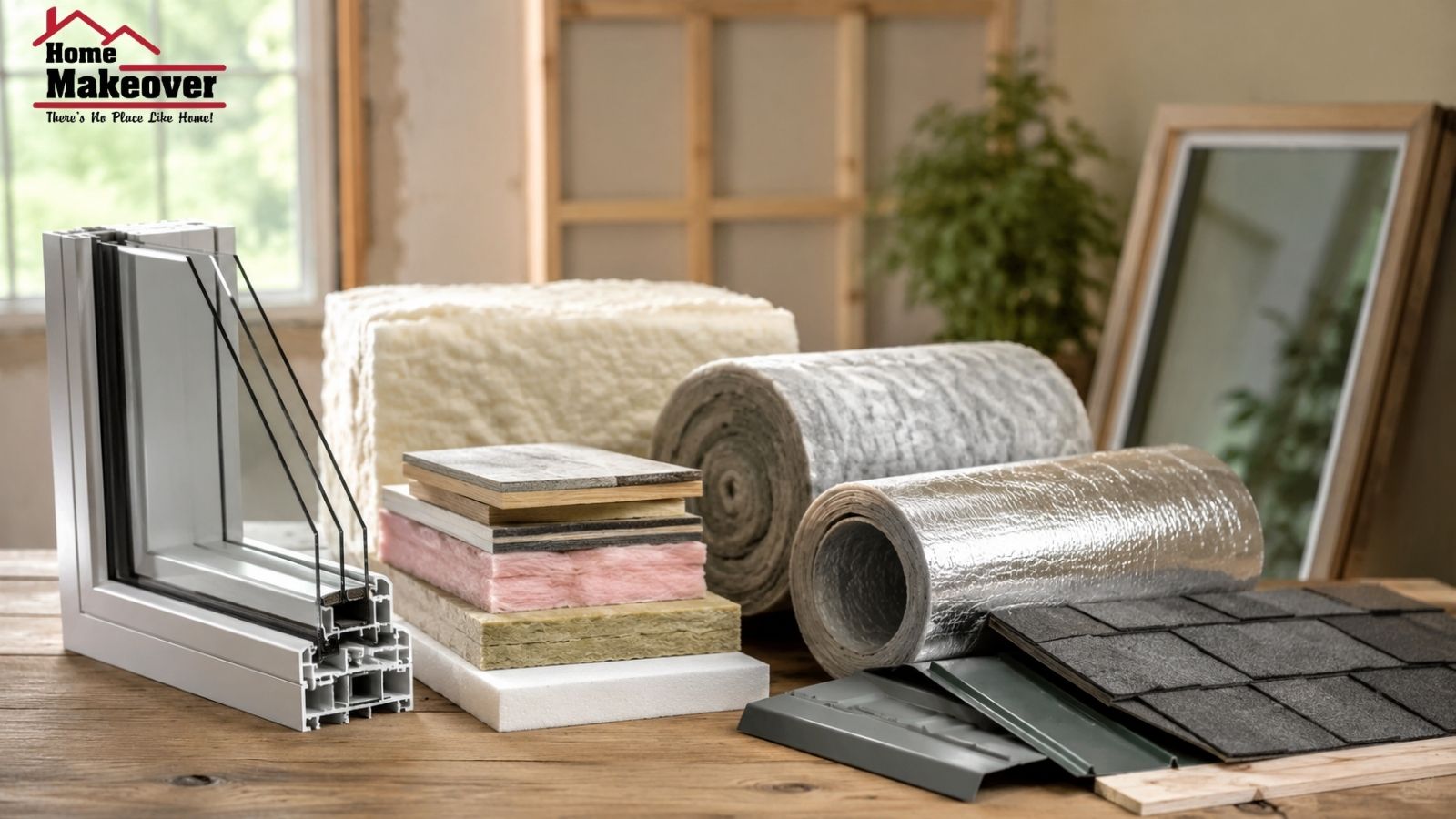
Fortunately, homeowners do not have to choose between appearance, durability, and energy performance. Modern Energy-Efficient Remodeling Materials can support all three.
Whether you are planning a whole-home renovation or improving one part of an older property, understanding how materials affect thermal performance can help you make better long-term decisions.
Older homes can have characteristics that make them less efficient than today’s renovated properties. Common issues include outdated windows, insufficient insulation, air gaps around doors and penetrations, aging roofing assemblies, and poorly sealed ductwork.
When the building envelope performs poorly, conditioned air escapes and outdoor temperatures have a greater influence on indoor conditions.
For example, imagine a Louisville home with an older set of single-pane or poorly performing windows. During a hot summer afternoon, solar heat enters through the glass while cooled indoor air is lost around deteriorated frames. The HVAC system must work harder to maintain the thermostat setting.
Replacing the windows may not solve every energy problem in the house, but it can address a significant source of heat transfer and air leakage.
The same principle applies to insulation and roofing. Energy efficiency is not created by one product alone. It comes from how multiple components work together.
A thoughtful renovation considers:
This is why homeowners researching home renovation services in Louisville or residential remodeling in Southern Indiana should evaluate performance as well as appearance.
Before choosing materials, it helps to understand the basic concept of heat transfer.
Heat naturally moves from warmer areas toward cooler areas. During winter, indoor heat attempts to escape through the building envelope. During summer, outdoor heat moves toward the cooler interior.
Three major mechanisms are involved:
An energy-efficient remodeling strategy attempts to control all three.
Adding insulation primarily reduces conductive heat transfer. Air sealing addresses unwanted airflow. Efficient windows can reduce conduction and solar heat gain.
The best results usually come from treating these elements as one system rather than making isolated upgrades.
Windows are one of the most visible components of a home, but they are also an important part of its thermal envelope.
Older windows may have poorly insulated frames, single-pane glass, deteriorated seals, or gaps around the installation. Modern insulated windows can provide substantially better thermal performance.
Several features influence window performance:
A window should not be judged solely by its appearance or number of panes. The climate, orientation of the window, shading conditions, and installation quality all matter.
For example, a south- or west-facing window may receive considerable afternoon solar exposure. Choosing glazing with appropriate solar-control characteristics can help manage unwanted heat gain.
One common remodeling mistake is assuming that buying a high-performance window automatically guarantees high performance.
It does not.
If the opening is poorly prepared or the window is inadequately sealed, air leakage can undermine the benefits of the new unit.
During a renovation, installers should pay attention to:
This is a practical example of why Energy-Efficient Remodeling Materials should be evaluated alongside installation methods.
Insulation is often hidden behind walls and ceilings, so homeowners may overlook it during remodeling. Yet it can have a major influence on thermal comfort and HVAC demand.
An insulation material slows the movement of heat through the building envelope. The effectiveness of an insulation assembly depends on factors such as its R-value, installation quality, continuity, moisture exposure, and air movement.
Spray foam insulation is frequently considered during renovations because it can provide both insulation and air-sealing benefits when appropriately specified and installed.
There are different types of spray foam, including open-cell and closed-cell products. Their properties differ in density, R-value, moisture behavior, and suitable applications.
Spray foam can be useful around difficult-to-seal areas such as:
However, more foam is not automatically better.
The product needs to be appropriate for the assembly and installed according to manufacturer requirements. Moisture management and ventilation considerations should also be evaluated.
Depending on the project, homeowners may consider:
The best choice depends on the location being insulated, available space, moisture conditions, desired performance, budget, and construction details.
A professional remodeling assessment should identify where insulation is missing or underperforming before simply adding more material.
The roof receives significant exposure to summer sun and winter weather, making the roofing assembly another important part of a home’s thermal performance.
A roofing replacement or renovation provides an opportunity to examine more than the exterior shingles.
A properly designed assembly may include:
Roof color and material properties can influence solar heat absorption. However, homeowners should avoid treating a reflective roof as a standalone solution.
If the attic floor has inadequate insulation or air leakage between the living space and attic, heat can still move into the house.
For this reason, roofing improvements are often most effective when considered alongside attic insulation and air sealing.
In some renovation scenarios, improving the attic assembly can produce a greater practical comfort improvement than simply changing the visible roofing material.
Energy efficiency and sustainability overlap, but they are not identical.
A material can be energy efficient during operation but have other environmental considerations. Conversely, a material may contain recycled content but provide limited thermal performance.
Homeowners interested in sustainable materials should therefore consider the complete application.
Useful questions include:
For example, durable flooring made with responsible materials may contribute to sustainability through longevity, while high-performance windows can reduce heat transfer during the home’s operational life.
The goal should not be to select the “greenest-looking” product. Instead, evaluate durability, performance, maintenance, and lifecycle considerations together.
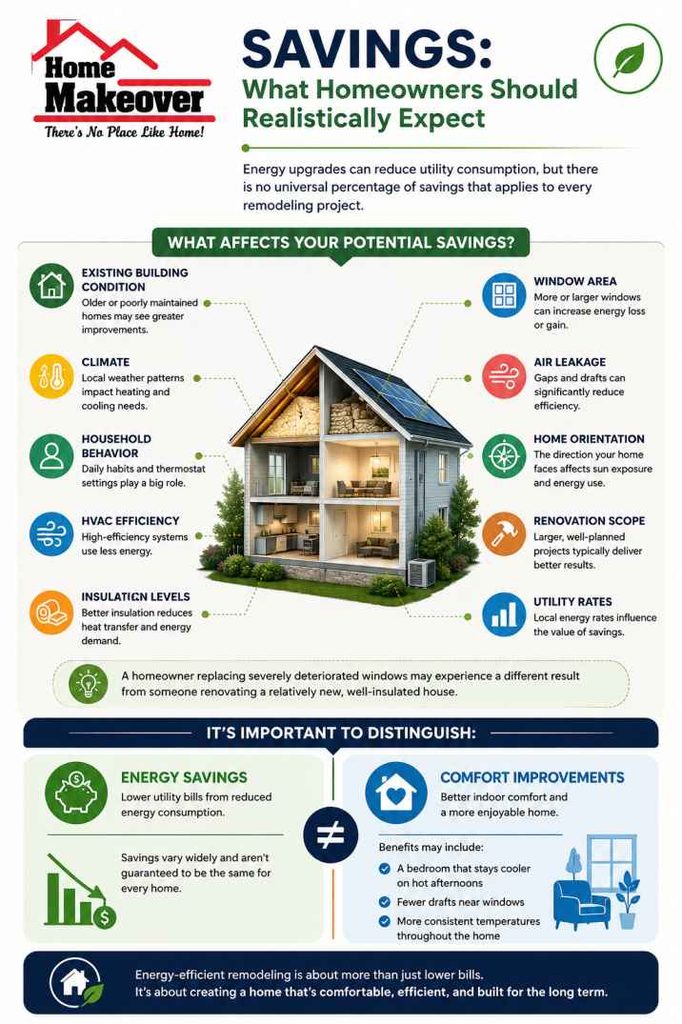
Energy upgrades can reduce utility consumption, but there is no universal percentage of savings that applies to every remodeling project.
Results depend on:
A homeowner replacing severely deteriorated windows may experience a different result from someone renovating a relatively new, well-insulated house.
It is also important to distinguish energy savings from comfort improvements.
Sometimes the most noticeable benefit is not a dramatically lower utility bill. It may be a bedroom that no longer becomes excessively hot in the afternoon, fewer drafts near windows, or more consistent temperatures between floors.
Those improvements have real value even when the monthly bill does not fall by a predictable amount.
A common mistake is to begin shopping for products before identifying the home’s biggest performance problems.
A better approach is to work from the building’s existing conditions.
Look for:
Adding insulation without controlling major air movement can limit the improvement.
Air can move through gaps around:
Once major air leakage and moisture concerns have been considered, insulation improvements can help establish a more continuous thermal barrier.
Prioritize windows that are damaged, drafty, difficult to operate, or especially exposed to unwanted solar gain.
If you’re already replacing roofing, investigate the condition and performance of the attic assembly rather than treating the roof covering as an isolated component.
The lowest purchase price does not necessarily represent the lowest long-term cost.
A cheaper window with poor thermal performance or installation requirements may not provide the same value as a higher-performing product.
Instead, consider purchase price, installation, durability, maintenance, and expected performance.
Insulation cannot compensate for every building-envelope problem.
If significant air leakage or moisture intrusion exists, those issues should be addressed first.
Even excellent materials can perform poorly when installed incorrectly.
This is especially important with windows, insulation, roofing components, and air-sealing products.
New windows may improve comfort, but if the attic is severely under-insulated and the walls have major air leakage, homeowners may still experience significant temperature fluctuations.
There is no single material that magically turns an inefficient home into an efficient one.
Performance comes from the interaction between the envelope, mechanical systems, ventilation, and occupant behavior.
When planning a renovation, evaluate the roof, walls, windows, doors, and foundation interfaces together.
A building-envelope approach often produces more useful results than choosing isolated upgrades based on marketing claims.
Energy efficiency should never come at the expense of moisture control.
Materials and assemblies need to be appropriate for the location and climate. Improperly installed insulation or air barriers can contribute to condensation or trapped moisture.
If a remodeling project significantly reduces heating and cooling loads, the existing HVAC system should be evaluated for compatibility with the renovated home.
Oversized equipment can create its own comfort and humidity-management issues.
Not every window needs exactly the same performance characteristics.
Solar exposure, shading, room use, and orientation should influence product selection.
For larger renovations, professional assessments such as blower-door testing, infrared imaging, or energy audits can help identify problems that are difficult to see during a normal walkthrough.
These tools can turn assumptions into measurable information.
Consider a hypothetical 1970s Louisville home with drafty windows, limited attic insulation, and inconsistent temperatures between the first and second floors.
The homeowner initially wants to replace all the windows.
A broader assessment reveals three separate issues:
Instead of treating window replacement as the entire solution, the remodeling plan addresses the envelope more comprehensively.
The homeowner selects high-performance insulated windows, improves attic insulation, seals accessible air leakage, and evaluates the attic ventilation and roofing assembly.
The result is not simply a collection of upgraded products. It is a more coherent thermal envelope.
This illustrates an important principle: the highest-value remodeling decision is often not choosing the most expensive material, but choosing the right material for the right problem.
Energy improvements should be incorporated into the remodeling budget from the beginning.
Create separate categories for:
Then prioritize projects based on condition and expected impact.
For example, replacing a window that is structurally failing is different from replacing a perfectly functional window solely for aesthetic reasons.
A phased approach can also make sense. A homeowner might address attic insulation and major air leakage during one renovation and tackle windows during a later project.
This approach can make energy efficient home remodeling in Southern Indiana more financially manageable without abandoning the long-term goal.
Before approving a material, ask:
These questions help separate genuine performance improvements from products that simply use “energy efficient” language in their marketing.
The best remodeling projects do more than make a house look newer. They improve how the home performs every day.
For homeowners considering energy efficient home remodeling in Southern Indiana, the smartest approach is to look beyond individual products and evaluate how windows, insulation, roofing, air sealing, and other Energy-Efficient Remodeling Materials work together.
In Louisville and Southern Indiana, where homes face both summer heat and winter cold, a stronger building envelope can support more consistent indoor temperatures and potentially reduce heating and cooling demand.
The key is prioritization.
Start by identifying where the home is losing energy or comfort. Choose materials based on the specific problem. Consider installation quality, moisture management, durability, and compatibility with existing construction. And avoid assuming that the most expensive product automatically delivers the best result.
Home Makeover Pro can help homeowners approach remodeling with these practical considerations in mind, creating renovation plans that balance appearance, comfort, durability, and energy performance.
There is no single best material for every home. High-performance insulated windows, properly selected insulation, air-sealing products, efficient roofing assemblies, and durable sustainable materials can all contribute to better building performance.
The right combination depends on the home’s age, existing construction, moisture conditions, orientation, and current deficiencies. A drafty older house may benefit more from air sealing and insulation improvements than from immediately replacing every finish material.
Potentially, but the answer depends on their condition and the rest of the building envelope.
If existing windows are drafty, damaged, difficult to operate, have failed seals, or contribute significantly to solar heat gain, replacement may provide meaningful comfort and performance benefits.
However, if the windows are already relatively efficient, improving attic insulation or air sealing may deliver better value. A good remodeling assessment should compare these opportunities rather than automatically recommending replacement.
No. Spray foam has useful properties, particularly its ability to provide insulation and air sealing in appropriate applications, but that does not make it universally superior.
Fiberglass, cellulose, mineral wool, and rigid foam can all be effective when properly selected and installed. Cost, location, moisture exposure, available cavity depth, fire considerations, and assembly design should influence the decision.
The quality of installation and overall assembly is often just as important as the insulation product itself.
It can, but savings vary substantially between homes.
The greatest opportunities often occur where a house has obvious deficiencies such as significant air leakage, inadequate insulation, inefficient windows, or poor building-envelope performance.
Utility savings also depend on thermostat settings, weather, HVAC equipment, occupancy, energy prices, and other factors. Homeowners should be cautious of contractors or product manufacturers promising a guaranteed percentage reduction without evaluating the property.
Often, yes. Major remodeling can provide access to areas that would otherwise be expensive or disruptive to modify.
For example, opening walls, replacing windows, renovating an attic, or replacing roofing can create opportunities to improve insulation, air sealing, flashing, and other building-envelope components at the same time.
Planning these improvements together can prevent situations where a newly finished area has to be reopened later to address an overlooked performance problem.