Address
SELLERSBURG, IN 47172


A successful Home Remodeling Project is not simply about choosing the most attractive tile, countertop, flooring, or fixtures. The materials you select have a direct impact on how your home looks, performs, ages, and holds up to everyday use.
This matters especially in Southern Indiana and Louisville, where homes experience seasonal temperature changes, humidity, heavy rainfall, and regular fluctuations between indoor and outdoor conditions. A material that looks impressive in a showroom may not necessarily be the right choice for a busy kitchen, moisture-prone bathroom, high-traffic hallway, or exterior application.
Homeowners also face another challenge: the enormous range of products available today. There are multiple grades of flooring, cabinets, countertops, insulation, windows, roofing products, plumbing fixtures, and finishes. Price alone rarely tells you which option offers the best value.
The better approach is to evaluate materials according to performance, application, maintenance, material durability, renovation quality, and long-term value.
Whether you are planning a kitchen update, bathroom renovation, basement finishing, whole-home renovation, or another improvement, this guide explains how to make informed material decisions. It also covers what experienced home improvement contractors in Louisville and professionals providing home remodeling services in Southern Indiana typically consider before recommending a product.
Materials are one of the biggest long-term decisions you will make during a renovation.
Paint can be changed relatively easily. A cabinet finish can sometimes be replaced. But replacing poorly selected flooring, countertops, windows, siding, insulation, or plumbing components can require substantial labor and additional disruption.
High-quality materials can contribute to:
However, “high quality” does not automatically mean “most expensive.”
A premium material can be unnecessary for a particular application, while a budget product can become expensive if it needs frequent repairs or replacement.
The objective is to select the right material for the right application.
Before comparing brands or finishes, consider how the room actually functions.
A material that works beautifully in a rarely used guest bathroom may perform poorly in a family bathroom used several times every day.
Ask yourself:
For example, a homeowner renovating a kitchen may fall in love with a delicate surface because of its appearance. But if the kitchen receives heavy daily use, a more stain-resistant and impact-resistant option may be the better investment.
The same principle applies to flooring. A visually attractive floor is not necessarily a practical floor for an entryway where wet shoes, grit, and heavy foot traffic are common.
Regional conditions should influence material selection.
Southern Indiana and Louisville experience four distinct seasons, including cold winter temperatures, hot and humid summers, and periods of significant rainfall. These conditions can affect building materials and the way assemblies perform.
For exterior or moisture-sensitive applications, contractors should consider:
For example, exterior materials need to tolerate repeated environmental exposure rather than simply look good immediately after installation.
Inside the home, humidity can also influence materials. Bathrooms, kitchens, laundry rooms, and basements require greater attention to moisture management than dry living areas.
This is why an experienced professional does not recommend materials solely from a catalogue. The location, application, installation method, and surrounding building system all matter.
One of the most common mistakes homeowners make is assuming that a higher price automatically means higher quality.
Instead, look at what the price represents.
For flooring, quality might relate to:
For cabinets, consider:
For countertops, examine:
A professional contractor should be able to explain why a particular material is appropriate, rather than simply saying that it is “better.”
If the explanation focuses only on price or appearance, ask more questions.
Even excellent materials can perform poorly when they are installed incorrectly.
This is particularly important because homeowners sometimes spend most of their time comparing products while giving insufficient attention to installation.
For example, a high-quality waterproof flooring product can still experience problems if the subfloor is improperly prepared. A premium tile can crack if the substrate or installation system is unsuitable. High-end windows may not perform as expected if they are poorly installed or improperly flashed.
This is where construction standards and workmanship become important.
Before approving a material, ask:
Material quality and installation quality should be considered together.
A remodeling decision should also respect the home’s existing architecture.
Southern Indiana and Louisville contain a wide range of housing styles and construction eras. A material that works well in a modern new-build aesthetic may look out of place in an older traditional home.
Before selecting finishes, consider:
This does not mean an older home must look traditional. Modern materials can work extremely well in older properties when they are integrated thoughtfully.
The goal is not to make every component identical. It is to create a finished result that feels intentional.
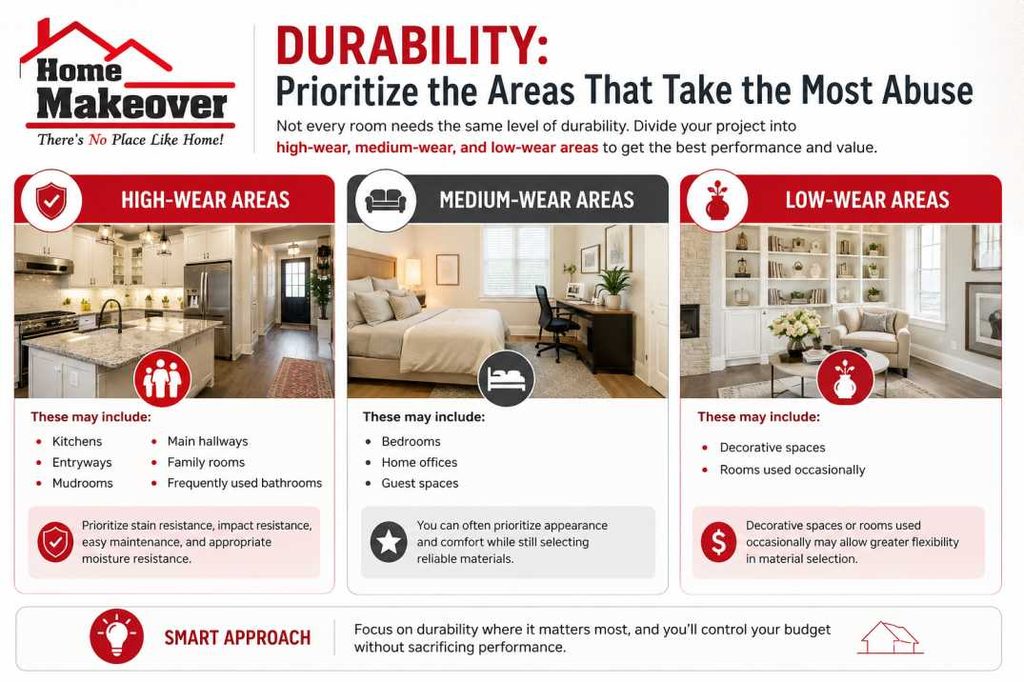
Not every room needs the same level of durability.
A useful strategy is to divide the project into high-wear, medium-wear, and low-wear areas.
These may include:
Prioritize stain resistance, impact resistance, easy maintenance, and appropriate moisture resistance.
Bedrooms, home offices, and guest spaces may not require the same specifications.
You can often prioritize appearance and comfort while still selecting reliable materials.
Decorative spaces or rooms used occasionally may allow greater flexibility in material selection.
This approach can help control the overall budget without sacrificing performance where it matters most.
Premium building materials can be worthwhile, but they should solve a specific problem.
Consider paying more when the upgraded material provides a meaningful benefit such as:
For example, investing in a durable countertop in a heavily used kitchen may make sense because replacing it later involves significant labor and disruption.
On the other hand, paying substantially more for a decorative finish in a low-use room may not provide an equivalent practical benefit.
A useful question is:
“What measurable benefit am I receiving for the additional cost?”
If the answer is unclear, investigate further.
Showrooms are designed to make products look appealing. That is useful, but appearance should be only one part of your evaluation.
When comparing remodeling products, look for:
Specifications can reveal information that is difficult to determine visually.
Depending on the product, check for:
A warranty is not a guarantee that something will never fail.
Read the actual conditions.
Check:
A long warranty is useful only when you understand what it actually protects.
Durability is more than surviving for many years.
A material may technically last a long time but require demanding maintenance to remain attractive.
When evaluating a product, ask:
How much work will this material require from me?
For example, homeowners should consider:
A slightly more expensive product that requires substantially less maintenance may provide better practical value over its useful life.
A high-quality renovation is a complete system.
The contractor needs to understand how different components interact.
Consider a bathroom renovation. Tile is only one component. The overall result also depends on:
If one critical component is neglected, the performance of the entire installation can suffer.
The same principle applies to kitchens, basements, flooring installations, exterior renovations, and additions.
This is why homeowners researching residential home remodeling in Southern Indiana should evaluate both the proposed materials and the contractor’s approach to installation.
A renovation should be evaluated over its expected useful life.
Imagine two flooring options:
The cheaper option may not actually be the less expensive choice over time.
A simple way to evaluate material value is to consider:
Initial cost + installation + maintenance + likely repairs + potential replacement
This does not produce a perfect financial calculation, but it provides a better framework than comparing purchase prices alone.
Long-term value is particularly important for materials that are difficult or expensive to replace.
Color matters, but it tells you very little about performance.
Always evaluate specifications and maintenance requirements before making the final decision.
The lowest initial price can sometimes result in higher long-term costs.
Ask why the product is less expensive and whether the difference affects durability or installation.
Some products require specific substrates, adhesives, fasteners, underlayments, or preparation methods.
Ignoring those requirements can create performance problems.
Ordering materials too early can create unnecessary waste or delays if dimensions change during demolition or preparation.
A material can be fashionable without being appropriate for your home.
Prioritize performance first, then aesthetics.
A product that is difficult to source can delay a project if replacement pieces or additional quantities become necessary.
Ask about lead times and product availability before committing.
Before approving materials for your Home Remodeling Project, ask your contractor:
An experienced contractor should welcome these questions.
Good professionals understand that homeowners are making a significant investment and deserve to understand the reasoning behind material recommendations.
If you are preparing for a renovation, use this five-step process.
Determine how the room will be used and what stresses the materials will experience.
Consider moisture, temperature changes, sunlight, ventilation, and other relevant factors.
Create a realistic budget that includes both material and installation costs.
Evaluate durability, maintenance, warranties, specifications, and expected service life.
Before purchasing, make sure the material is compatible with the existing structure and planned installation method.
This process helps prevent decisions based entirely on showroom appearance or initial price.
You do not have to choose between a beautiful home and a durable home.
The strongest remodeling decisions balance three factors:
Appearance + Performance + Cost
If you focus only on appearance, you may choose products that are difficult to maintain.
If you focus only on performance, you may end up with a finished space that does not reflect your preferences.
If you focus only on price, you may compromise longevity.
Instead, identify where your budget matters most.
For example, you might invest more in:
And control costs through carefully selected finishes in lower-impact areas.
This creates a more balanced renovation without unnecessarily increasing the entire project budget.
The best material for a Home Remodeling Project is not necessarily the most expensive, newest, or trendiest option.
It is the material that fits the home’s structure, the room’s purpose, the local environment, your maintenance expectations, and your long-term budget.
When evaluating materials, look beyond appearance and price. Consider material durability, construction standards, renovation quality, maintenance, installation requirements, and long-term value.
Whether you are researching home remodeling services in Southern Indiana, comparing home improvement contractors in Louisville, or planning residential home remodeling in Southern Indiana, taking the time to understand your material choices can make the entire renovation more successful.
A well-planned project combines good design with appropriate products and sound installation practices. That approach can help your remodeled space remain attractive, functional, and dependable for years to come.
Start with the room’s function, moisture exposure, traffic level, maintenance requirements, expected lifespan, installation requirements, and budget. A suitable material should perform well under the actual conditions it will experience.
For example, a busy family kitchen requires different material considerations than a rarely used guest room. Discussing these conditions with a qualified remodeling professional can help narrow the options.
No. Premium products can offer advantages, but the most expensive option is not automatically the most appropriate.
A higher-priced product is worth considering when it provides a meaningful improvement in durability, maintenance, performance, warranty coverage, or service life. The key is matching the product to the application rather than paying for features you do not need.
Seasonal temperature changes, humidity, rainfall, and freeze-thaw conditions can affect different materials, particularly exterior products and moisture-sensitive assemblies.
Interior spaces such as bathrooms, kitchens, laundry rooms, and basements also require careful consideration of moisture management. Contractors should evaluate the complete installation rather than choosing products in isolation.
It depends on the project and contractor arrangement.
Homeowners can sometimes purchase selected finishes themselves, but doing so without understanding quantities, specifications, lead times, compatibility, or installation requirements can create problems.
For many projects, it is more efficient to coordinate material procurement with the remodeling team, particularly for products that require professional installation or have manufacturer-specific requirements.
Ask the contractor to explain why a particular material is being recommended.
A knowledgeable professional should be able to discuss performance, durability, maintenance, installation requirements, warranty considerations, and alternatives.
Be cautious if recommendations are based only on statements such as “this is the best” without a clear explanation of how the product fits your project.