Address
SELLERSBURG, IN 47172

Choosing the right materials can determine whether a remodeling project looks impressive for a few years or continues performing well for decades. This is especially important for homeowners planning home remodeling in Louisville, where seasonal temperature changes, humidity, rainfall, and freeze-thaw conditions can affect everything from siding and roofing to flooring and cabinetry.
A material that performs well in a dry climate may not be the best choice for a home exposed to Louisville’s moisture and seasonal fluctuations. The same principle applies to homeowners considering home remodeling in Southern Indiana. While aesthetics and budget matter, long-term performance should be part of the decision from the beginning.
So, what remodeling materials work best for homes in Louisville and Indiana? The answer depends on where the material will be installed, how much moisture it will encounter, how temperatures change throughout the year, and how much maintenance the homeowner is willing to perform.
This guide explores practical material choices for kitchens, bathrooms, roofs, floors, siding, windows, and other remodeling applications. It also explains how current home remodeling trends in Louisville are influencing material selection without sacrificing durability.
Louisville homes experience a broad range of weather conditions throughout the year. Summers can bring heat and humidity, while winters introduce cold temperatures, precipitation, and occasional freeze-thaw cycles.
These environmental conditions create several challenges for remodeling materials.
Wood, for example, naturally responds to moisture. It can absorb and release water vapor as environmental conditions change. If installation and sealing are inadequate, repeated changes can contribute to warping, cracking, swelling, or premature deterioration.
Exterior products face even greater exposure.
Rain, sunlight, temperature fluctuations, wind, and humidity can gradually degrade materials that are not suited to the local environment.
This is why good remodeling decisions go beyond asking, “What looks good?”
Homeowners should also ask:
These questions help homeowners evaluate materials based on performance rather than appearance alone.
Climate should influence material selection at the design stage rather than after problems appear.
For home remodeling in Louisville, one of the most important considerations is moisture. Humid summers, rainfall, condensation, and poor ventilation can all introduce moisture into areas where it can cause problems.
Materials with strong humidity resistance can be particularly valuable in bathrooms, kitchens, basements, laundry areas, and exterior applications.
Porcelain tile, properly finished engineered wood, moisture-resistant drywall products designed for appropriate applications, fiber-cement siding, and certain composite materials can perform well when correctly selected and installed.
However, even a moisture-resistant material is not waterproof simply because it carries that label.
Installation still matters.
For example, a bathroom floor may use porcelain tile, but water can still reach the subfloor if the underlying waterproofing system is poorly installed.
The material and the assembly must work together.
Temperature and moisture changes can cause materials to expand and contract.
This is known as seasonal expansion, and it is particularly important when working with wood, engineered flooring, exterior siding, trim, and other materials affected by environmental conditions.
A common remodeling mistake is treating expansion gaps as unnecessary imperfections.
They are not.
Properly designed expansion allowances give materials room to move without buckling or separating.
Experienced home remodeling contractors in Indiana understand that installation tolerances are just as important as product selection.
Interior spaces allow homeowners to experiment with colors, textures, and finishes, but performance should remain a priority.
Flooring receives constant wear, making durability one of the most important selection criteria.
For kitchens, entryways, mudrooms, and bathrooms, porcelain tile is a strong option because it is dense, water-resistant, and relatively easy to maintain.
Luxury vinyl flooring can also be practical in areas where homeowners want a wood or stone appearance combined with easier maintenance.
Engineered hardwood can provide the appearance of natural wood while offering greater dimensional stability than some solid-wood applications.
However, no flooring product should be selected solely because it is marketed as “waterproof” or “durable.”
Ask about:
A beautiful floor installed over an unsuitable or poorly prepared subfloor can still fail prematurely.
Kitchen countertops need to tolerate spills, heat, food preparation, cleaning products, and daily use.
Quartz remains a popular choice because it offers a wide variety of appearances and generally requires less routine sealing than many natural stones.
Granite can also be a strong option, particularly when homeowners appreciate natural variation. Depending on the stone, periodic sealing may be appropriate.
Porcelain slabs are another material gaining attention because they can provide a stone-like appearance while offering strong resistance to stains, heat, and moisture when properly installed.
The best countertop depends on the homeowner’s priorities.
A household that cooks heavily every day may prioritize stain resistance and easy maintenance. Another homeowner may care more about natural character and be comfortable with periodic maintenance.
Cabinet construction matters more than many homeowners realize.
Solid wood, plywood, medium-density fiberboard, and particleboard can all have legitimate applications, but their performance varies depending on construction quality, moisture exposure, finish, and installation.
For kitchens and bathrooms, cabinet components should be selected with moisture exposure in mind.
Areas beneath sinks deserve particular attention because small plumbing leaks can remain unnoticed until cabinet materials have already absorbed significant moisture.
A useful remodeling strategy is to plan for serviceability. If a sink leak occurs, homeowners should be able to access plumbing connections without destroying cabinetry.
Exterior materials have to deal directly with the weather, making material performance especially important.
Siding should not be viewed simply as a decorative outer skin.
A properly designed exterior wall assembly may include siding, flashing, weather-resistant barriers, drainage paths, sealants, and appropriately detailed openings around windows and doors.
These components work together to provide moisture protection.
Fiber-cement siding is one option homeowners may consider because it combines a traditional appearance with resistance to many common exterior durability concerns.
Engineered wood siding can provide another aesthetic option when installed and maintained according to manufacturer requirements.
Vinyl siding can also be practical for homeowners who prioritize relatively low maintenance and cost efficiency.
The critical point is that no siding material compensates for poor flashing or water-management details.
If water enters around a window and cannot drain properly, replacing the siding alone may not solve the underlying problem.
Roofing deserves special attention because the roof protects almost every other part of the home.
Roofing durability depends on several factors:
Asphalt architectural shingles remain a common residential choice because they provide a balance between cost, appearance, and service life.
Metal roofing can provide long-term durability and is available in designs that complement traditional and contemporary homes.
Synthetic roofing products may also be appropriate in certain applications.
However, homeowners should avoid comparing roofing systems strictly by the manufacturer’s stated lifespan.
Installation details can have a major effect on actual performance.
A premium roofing product installed poorly may perform worse than a more moderately priced product installed correctly.
Replacing windows and doors during a remodel can improve comfort, but the surrounding installation is just as important as the product itself.
Modern windows can improve energy performance through features such as insulated glass, low-emissivity coatings, and improved frame designs.
But homeowners should also pay attention to:
Poorly installed windows can allow air and water infiltration even when the window itself has strong performance specifications.
Insulation should also be evaluated as part of a complete building-envelope strategy.
Simply adding insulation without considering air leakage and moisture movement can produce disappointing results.
The goal should be a balanced envelope that controls heat flow, air movement, and moisture appropriately.
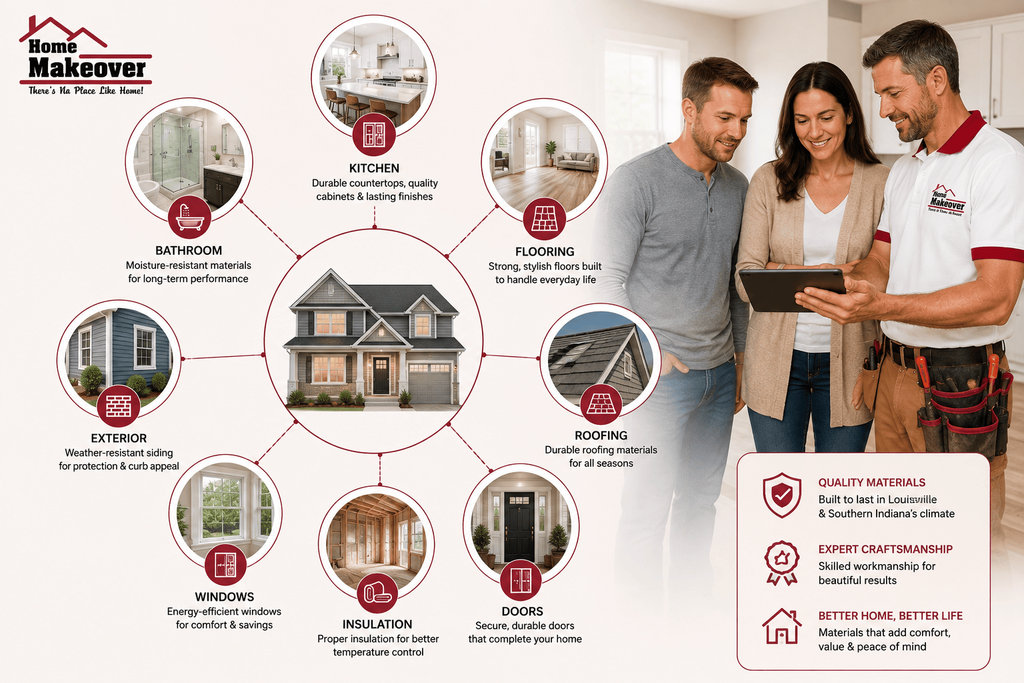
Sustainability is becoming increasingly relevant to home remodeling trends in Louisville.
However, climate-friendly construction is not limited to installing the newest environmentally marketed product.
A durable material that lasts longer can sometimes provide greater long-term value than a cheaper material that requires frequent replacement.
Homeowners can consider:
Reducing waste during construction is another practical sustainability strategy.
Careful measurements, responsible material ordering, reuse of suitable existing components, and thoughtful demolition can reduce unnecessary disposal.
The most sustainable remodeling project is often one that solves the underlying problem correctly the first time.
Kitchens and bathrooms are among the most material-intensive areas of a home.
They combine water, heat, cleaning products, heavy use, and frequent temperature changes.
For bathrooms, homeowners should prioritize moisture management before decorative finishes.
A well-designed bathroom may use porcelain tile, waterproofing membranes, appropriate backer materials, moisture-resistant finishes, and properly sealed transitions.
For kitchens, countertops and backsplashes should tolerate routine exposure to water and food preparation.
Cabinet hardware should also be chosen for frequent use. Soft-close hinges and drawer slides can reduce everyday wear, although the quality of the cabinet construction remains more important than the hardware alone.
A common mistake is trying to choose the cheapest material in every category.
Another mistake is assuming the most expensive product is automatically the best.
A better approach is to divide remodeling materials into three categories:
Spend more time and budget on components that are difficult or expensive to replace later.
Examples include:
Prioritize durability where daily use is intense.
Examples include:
These can often be changed later without major construction.
Examples include:
This approach helps homeowners spend money where it has the greatest long-term impact.
A material can look excellent in a showroom but perform poorly in a particular application.
Always consider the environment where it will be installed.
Homeowners sometimes focus heavily on tile, siding, or flooring while overlooking waterproofing, flashing, drainage, and ventilation.
The visible finish is only one part of the system.
Even moisture-resistant products require correct installation.
Water can exploit gaps, joints, penetrations, and poorly sealed transitions.
Different materials can respond differently to temperature and moisture.
Expansion, contraction, fastening requirements, adhesives, sealants, and transition details should be considered before combining products.
Material decisions can affect dimensions, electrical locations, plumbing rough-ins, framing, and installation sequencing.
Choosing major products early helps reduce redesign and ordering problems.
Experienced remodelers tend to focus on details that homeowners may not notice until something goes wrong.
Here are several practical recommendations.
If the exterior cannot control water and air effectively, interior finishes will not solve the problem.
Tile, flooring, countertops, and siding all depend on the surface beneath them.
A premium finish installed over an unsuitable substrate remains a weak system.
Ask yourself how often the material needs cleaning, sealing, repainting, refinishing, or replacement.
A slightly higher initial cost may make sense if it significantly reduces maintenance over the material’s useful life.
Material performance should match the room and exposure.
A bathroom floor, basement wall, exterior deck, and bedroom floor do not need identical material specifications.
Before finalizing a material, consider what happens if one section becomes damaged.
Can an individual board, tile, panel, or component be replaced?
This question is particularly valuable for flooring and exterior finishes.
Installation instructions are not optional suggestions.
They can specify required underlayments, fasteners, expansion gaps, sealants, ventilation, moisture conditions, and approved substrates.
Following those requirements protects both performance and warranty coverage.
Current home remodeling trends in Louisville increasingly combine visual appeal with practical performance.
Homeowners are showing greater interest in materials that are attractive but also easier to maintain and better suited to everyday living.
Several trends are particularly relevant:
The underlying trend is more important than any individual product: homeowners increasingly want materials that provide both design flexibility and dependable performance.
The principles discussed here also apply to home remodeling in Southern Indiana, although individual homes can present different construction conditions.
Older properties may have different wall assemblies, existing moisture problems, outdated electrical systems, or previous remodeling work that affects the current project.
Before selecting materials, homeowners should understand the existing building.
For example, installing new flooring may appear straightforward until an inspection reveals an uneven subfloor or elevated moisture levels.
Likewise, replacing siding without investigating existing water intrusion can hide rather than solve the problem.
This is why material selection should be based on the home’s actual conditions rather than a generic remodeling checklist.
When evaluating home remodeling contractors in Indiana, homeowners should ask specific questions about materials and installation rather than focusing exclusively on the project price.
Useful questions include:
A knowledgeable contractor should be able to explain the reasoning behind a recommendation rather than simply naming a product.
The goal is not to choose the most expensive material.
The goal is to choose a material system that fits the home’s conditions, the homeowner’s budget, and the expected service life.
Before approving your remodeling materials, review these points:
Performance
Durability
Maintenance
Installation
Climate
Repairability
Budget
Long-Term Value
This checklist can help turn material selection from an aesthetic decision into a long-term investment decision.
The best remodeling materials are not necessarily the newest, most expensive, or most fashionable products. They are materials that perform reliably within the conditions where they are installed.
For home remodeling in Louisville, homeowners should pay particular attention to humidity resistance, seasonal expansion, moisture protection, exterior performance, and roofing durability. These considerations can have a greater effect on long-term satisfaction than choosing a particular color or finish.
The same principle applies to home remodeling in Southern Indiana. Existing construction, exposure, maintenance expectations, and budget should all influence material selection.
As home remodeling trends in Louisville continue to evolve, the strongest projects will combine contemporary design with proven building practices. Durable flooring, well-installed roofing, appropriate exterior materials, effective insulation, quality windows, and properly waterproofed wet areas can all contribute to a home that looks good while performing well.
Before choosing a product, ask the most important question: Will this material continue to perform in this specific part of my home, under Louisville’s changing conditions, for the amount of time I expect it to last?
That question can lead to better decisions, fewer premature repairs, and a remodeling result that remains valuable long after the project is finished.
The best materials depend on the application, but homeowners should generally prioritize products that can tolerate humidity, temperature changes, moisture exposure, and regular use. Porcelain tile, appropriately selected engineered flooring, durable exterior siding, quality roofing systems, energy-efficient windows, and moisture-conscious construction assemblies can all be suitable choices. The installation method is just as important as the material itself.
Louisville’s combination of humid conditions, rainfall, summer heat, winter cold, and seasonal temperature changes can affect materials differently. Wood products may experience dimensional movement, exterior finishes can weather over time, and poorly protected building assemblies may develop moisture problems. Material selection should therefore consider humidity resistance, seasonal expansion, drainage, ventilation, and moisture protection.
Water management should come before decorative finishes. Homeowners should evaluate waterproofing, substrate preparation, drainage, ventilation, tile installation, and sealed transitions. Porcelain tile can be a durable surface, but it does not replace a properly designed waterproofing system. The objective is to prevent water from reaching vulnerable components behind the visible finishes.
No. Price alone does not determine performance. A moderately priced material that is correctly specified and installed can outperform a premium product installed incorrectly. Homeowners should compare total installed cost, expected service life, maintenance requirements, repairability, environmental suitability, and installation requirements before making a decision.
Focus on durable base materials and use easily replaceable finishes for trends. For example, homeowners can select long-lasting flooring, countertops, roofing, windows, and exterior products while incorporating current styles through paint, lighting, hardware, furnishings, and other easier-to-update features. This approach allows the home to reflect current home remodeling trends in Louisville without requiring major renovations every few years.