
Tag Archives: home remodeling Louisville

How to Plan a Remodeling Budget in Louisville & Southern Indiana Without Going Overboard

Remodeling a home can be one of the most rewarding improvements a homeowner makes, but it can also become difficult to manage when the original plan keeps changing. A project that begins with a clear vision can gradually expand as new ideas, material selections, hidden conditions, and unexpected decisions enter the picture.

For homeowners researching a home remodeling budget in Louisville, the challenge is not simply determining what a renovation might cost. The more important challenge is creating a financial framework that remains practical throughout the project.

The same principle applies to homeowners considering home renovation services in Southern Indiana. Whether you are updating a kitchen, renovating a bathroom, improving several living areas, or completing a larger whole-home renovation, good planning can make the process considerably easier to control.

A well-planned Remodeling Budget does not attempt to predict every possible event. Instead, it establishes priorities, defines the scope, accounts for uncertainty, and creates a process for making decisions when circumstances change.

This guide explains how homeowners can approach remodeling budget planning more strategically, what commonly causes projects to drift, and how to work effectively with home improvement contractors in Louisville without losing control of the original vision.

Budget Planning Should Begin Before You Choose Materials

Many homeowners begin their renovation by looking at flooring, countertops, cabinets, fixtures, paint colors, appliances, and other finishes.

While product research is useful, it should not be the first stage of financial planning.

The first step is understanding the project itself.

Ask:

  • What problem is the renovation supposed to solve?
  • Which areas of the home need improvement?
  • What needs to change for the home to function better?
  • Which improvements are essential?
  • Which features are preferences rather than necessities?
  • Is the goal improved functionality, appearance, comfort, durability, or a combination?
  • Are structural, electrical, plumbing, or other technical changes likely to be involved?

These questions establish the foundation of the project.

For example, a homeowner may initially describe a project as a kitchen renovation. However, after considering how the space is actually used, the real project may involve improving storage, changing the workflow, updating lighting, addressing outdated electrical components, improving ventilation, and replacing worn finishes.

The more clearly the underlying goals are defined, the easier it becomes to decide where the Remodeling Budget should be concentrated.

Remodeling Scope Is the Foundation of Financial Control

One of the most common reasons remodeling projects become difficult to manage is scope expansion.

Scope expansion occurs when additional work is gradually added after the original project has already been established.

A homeowner might begin with a bathroom renovation and later decide to replace adjacent flooring. Then they may consider repainting another room, replacing a door, adding lighting, or modifying storage.

None of these individual decisions necessarily seems significant. The problem is that several small additions can collectively change the character of the project.

Before construction begins, create a clear scope of work.

The scope should identify:

  • Areas included in the renovation
  • Demolition requirements
  • Layout changes
  • Construction work
  • Electrical requirements
  • Plumbing requirements
  • Heating or cooling considerations where relevant
  • Cabinetry and built-ins
  • Flooring
  • Lighting
  • Fixtures
  • Appliances
  • Painting and finishing
  • Cleanup and disposal
  • Any known exclusions

This does not mean every product must be selected immediately.

It means the boundaries of the project should be understood.

A clearly defined scope allows your contractor to develop a more useful remodeling estimate and gives you a reference point whenever a new idea comes up.

Costs Should Be Organized by Priority

A useful remodeling plan separates expenses according to importance rather than treating every feature equally.

Start with the elements that directly affect safety, function, durability, and the intended purpose of the renovation.

For example, during a kitchen remodel, functional cabinetry, appropriate electrical work, adequate lighting, plumbing requirements, and durable surfaces may take priority over decorative upgrades.

During a bathroom renovation, waterproofing, ventilation, plumbing, drainage, and appropriate installation practices may deserve greater attention than cosmetic accessories.

This approach helps homeowners make rational decisions when trade-offs become necessary.

A useful priority system can include:

Essential work

These are items that are fundamental to the project and should remain part of the plan.

Functional improvements

These make the space work better and can have a meaningful effect on everyday use.

Design enhancements

These improve appearance, personalization, or overall finish quality.

Optional upgrades

These are desirable but can potentially be postponed without affecting the core purpose of the renovation.

This structure prevents optional features from consuming resources that should be reserved for essential work.

Estimate Quality Matters More Than a Single Number

A remodeling estimate should help you understand the project, not simply provide a total figure.

When reviewing estimates from contractors, look beyond the final amount.

Consider whether the proposal explains:

  • What work is included
  • What materials are included
  • Which items are allowances
  • What preparation is required
  • Which trades are involved
  • What is specifically excluded
  • What assumptions were made
  • How changes will be handled
  • How unforeseen conditions will be communicated

Two estimates can appear very different because they are based on different scopes.

For example, one proposal may include extensive preparation and finishing while another may assume that certain work will be handled separately.

This is why comparing contractors solely by the lowest estimate can be misleading.

The better question is:

“Am I comparing equivalent scopes of work?”

A detailed proposal can make that comparison much easier.

Contractor Selection Should Include Communication Skills

Choosing among home improvement contractors in Louisville involves more than comparing experience, availability, and project photographs.

Communication is an important part of budget management.

A contractor should be able to explain why certain work is necessary, what assumptions were used in the estimate, where uncertainty exists, and how changes will be handled.

Before hiring, ask practical questions such as:

  • How do you handle unexpected conditions?
  • How are changes documented?
  • When will I be informed about additional work?
  • Which selections need to be finalized before construction?
  • Which portions of the estimate are based on allowances?
  • How do you coordinate different trades?
  • How do you communicate schedule changes?
  • What information do you need from me before work begins?

Pay attention not only to the answers but also to how clearly the contractor explains them.

A renovation involves many decisions. Clear communication can prevent misunderstandings from becoming financial problems later.

Contractor Selection Should Include Communication Skills

Labor Pricing Depends on More Than Time on the Job

Labor pricing is influenced by the complexity and coordination involved in a renovation.

A project requiring straightforward replacement work is fundamentally different from one involving structural modifications, detailed finish carpentry, plumbing relocation, electrical upgrades, difficult demolition, or coordination among several specialty trades.

Labor can also be affected by site accessibility and the existing condition of the property.

This is particularly relevant when renovating older homes.

Existing construction may contain previous modifications, outdated systems, concealed damage, or installation methods that require additional attention.

Homeowners should therefore avoid assuming that labor can be judged simply by the number of days workers are physically present.

The work before and after installation can also matter.

Preparation, demolition, protection of existing areas, material handling, installation, adjustment, finishing, inspection, and cleanup may all contribute to the overall labor involved.

Material Inflation Makes Early Planning More Important

Material inflation and product availability can affect remodeling decisions.

Prices and availability for building materials, fixtures, appliances, cabinetry, and specialty products can change over time. Products may also be discontinued, delayed, or replaced with newer versions.

This is why homeowners should avoid building their entire plan around old renovation examples found online.

Instead:

  • Check current product availability.
  • Confirm lead times.
  • Ask whether selections are readily available.
  • Avoid waiting until the last minute for major selections.
  • Understand whether an allowance reflects the type of product you actually want.
  • Keep alternative products in mind for items with uncertain availability.

Early planning reduces the likelihood of making rushed decisions later.

It also makes it easier to identify which selections are important enough to finalize before construction starts.

A Contingency Fund Protects the Remodeling Plan

Every renovation involves some degree of uncertainty.

A contingency fund is designed to provide financial flexibility when legitimate unforeseen conditions arise.

It should not be treated as money available for spontaneous upgrades.

Potential unexpected conditions can include:

  • Hidden moisture damage
  • Deteriorated framing
  • Damaged subflooring
  • Previously concealed plumbing issues
  • Outdated electrical components
  • Unexpected demolition complications
  • Existing construction that does not match assumptions
  • Repairs required after opening an enclosed area

The appropriate contingency depends on the type of renovation and the level of uncertainty involved.

A project involving extensive demolition in an older property generally has different risks from a limited cosmetic update.

The important principle is to establish contingency before work begins and protect it throughout the project.

If the contingency is spent on optional design upgrades early in the renovation, it cannot perform its intended purpose later.

Planning for Existing Home Conditions

New construction and remodeling are not the same.

When building a new home, much of the construction environment is known before work begins. Remodeling involves working with an existing structure.

That structure has a history.

Previous homeowners may have altered rooms, added electrical circuits, moved plumbing, enclosed spaces, replaced materials, or completed repairs that are not immediately visible.

Once demolition begins, the contractor may discover conditions that could not reasonably be confirmed beforehand.

This is one reason homeowners should be cautious about expecting an exact final outcome before existing conditions are fully understood.

The best approach is not to assume that everything will go wrong.

Instead, recognize that some uncertainty exists and create a budget and decision process capable of responding to it.

Remodeling Decisions Should Be Made Before They Become Urgent

One of the easiest ways for a project to become financially difficult is to delay important decisions until construction is already underway.

When contractors are waiting for selections, homeowners may feel pressured to choose quickly.

Rushed decisions can lead to:

  • Choosing products without sufficient research
  • Selecting alternatives that do not fit the original design
  • Paying more for expedited options
  • Changing previously completed work
  • Creating coordination problems with other trades

Whenever possible, establish major selections before they are needed on site.

Depending on the project, this may include:

  • Cabinets
  • Flooring
  • Countertops
  • Plumbing fixtures
  • Lighting
  • Appliances
  • Doors
  • Hardware
  • Tile
  • Paint finishes

Not every detail needs to be decided at the same time, but decisions should be scheduled rather than left until the last moment.

Use a Change Management Process

Changes are sometimes unavoidable.

The problem is not necessarily the existence of changes. The problem is approving changes without understanding their broader effect.

Before approving a modification, consider four questions:

What is changing?

Clearly identify the new work or product.

Why is it changing?

Determine whether the change is necessary, functional, aesthetic, or simply a new preference.

What else does it affect?

A change to one component may affect another trade, material, installation method, or schedule.

What is the documented financial impact?

The homeowner should understand the effect before approving the change.

This process creates accountability for both the homeowner and contractor.

It also makes it easier to distinguish legitimate unforeseen work from optional project expansion.

Cost Planning Should Include the Entire Project Lifecycle

Homeowners sometimes concentrate entirely on construction and forget about related expenses.

Depending on the renovation, consider whether the project may involve:

  • Temporary living arrangements
  • Storage
  • Moving furniture
  • Appliance relocation
  • Temporary kitchen arrangements
  • Additional cleaning
  • Replacement of damaged or incompatible items
  • Post-construction maintenance
  • Landscaping or exterior restoration after certain projects

These considerations may not be part of the contractor’s construction scope.

Including them in your overall planning prevents unrelated project expenses from becoming unexpected financial pressure.

Financing Options Should Support the Plan

Some homeowners use financing options to fund a renovation.

If financing is part of your strategy, treat it as a financial tool rather than an invitation to expand the project.

Consider:

  • Repayment obligations
  • Interest costs
  • Loan terms
  • Cash-flow requirements
  • Existing financial commitments
  • Emergency savings
  • Potential changes to the project scope

A renovation should remain financially comfortable after considering the financing structure.

It can be useful to establish your project priorities first and then determine how financing fits those priorities.

Do not reverse the process by deciding how much you can borrow and then designing the renovation around that amount.

Southern Indiana Homeowners Should Apply the Same Planning Principles

Homeowners seeking home renovation services in Southern Indiana can use the same fundamental approach.

Whether the property is in Southern Indiana or Louisville, the core budgeting principles remain consistent:

  • Define the scope.
  • Identify priorities.
  • Understand the existing property.
  • Review the contractor’s estimate carefully.
  • Confirm allowances.
  • Consider material availability.
  • Establish contingency.
  • Document changes.
  • Track decisions.
  • Communicate throughout construction.

The specific property, construction conditions, design goals, and contractor scope will determine the details.

The important point is that a renovation budget should be customized to the actual project rather than copied from a generic online remodeling calculator or another homeowner’s experience.

Common Mistakes That Make a Remodeling Budget Difficult to Control

Several habits repeatedly create problems during renovations.

Starting without a defined scope

Without clear boundaries, it becomes difficult to determine whether a new request is part of the original project or an additional expense.

Choosing a contractor entirely because of the lowest estimate

A low initial figure may reflect differences in scope, allowances, exclusions, or assumptions.

Ignoring allowances

An allowance that does not reflect realistic product preferences can make the budget appear more predictable than it really is.

Using contingency for upgrades

This eliminates protection against genuine unforeseen conditions.

Changing the layout after construction starts

Layout changes can affect several trades and create additional work beyond the original modification.

Making too many decisions during construction

Last-minute decisions increase the likelihood of rushed or inconsistent choices.

Failing to track changes

Even small additions should be documented so the homeowner understands their cumulative effect.

Expert Advice for a More Predictable Remodeling Experience

A practical approach to remodeling is to think of the budget as a living document.

The original plan establishes the framework, but the budget should be reviewed as decisions are finalized.

Keep track of:

  • Original scope
  • Approved changes
  • Material selections
  • Allowances
  • Remaining contingency
  • Completed work
  • Pending decisions
  • Upcoming commitments

You do not need a complicated financial system.

A simple, consistently maintained record can provide much better visibility than relying on memory.

It is also useful to schedule regular project conversations with your contractor.

Ask what decisions are coming next, whether anything has changed, and whether there are newly discovered conditions that could affect the plan.

This creates an opportunity to address issues while they are still manageable.

How Home Makeover Pro Approaches Remodeling Planning

At Home Makeover Pro, the goal of a remodeling conversation should not be limited to producing an estimate.

A successful renovation begins with understanding what the homeowner wants to accomplish, what the existing property can support, and which decisions are most important to the overall project.

Good planning means discussing the scope clearly, identifying assumptions, explaining potential uncertainties, and establishing a practical process for handling changes.

For homeowners considering a home remodeling budget in Louisville or exploring renovation possibilities in Southern Indiana, this approach can provide a stronger foundation for making informed decisions.

The objective is not to promise that a renovation will never encounter an unexpected condition.

The objective is to make sure homeowners understand their project well enough to respond intelligently when something changes.

Final Takeaway

A well-controlled Remodeling Budget is built around planning rather than guesswork.

Start by defining what the renovation needs to accomplish. Separate essential improvements from optional upgrades. Establish a clear scope before comparing estimates. Review allowances and exclusions carefully. Understand how labor and materials contribute to the project. Maintain a contingency fund for genuine uncertainty and use a documented process for changes.

Most importantly, stay involved in the decision-making process.

Homeowners do not need to control every construction detail, but they should understand what is being built, what decisions are approaching, and how changes affect the overall plan.

Whether you are planning a renovation in Louisville or researching home renovation services in Southern Indiana, thoughtful cost planning can help turn a complicated remodeling project into a more organized and manageable experience.

The strongest remodeling budget is not the one that predicts every detail perfectly. It is the one that gives you a clear plan, realistic priorities, and enough flexibility to make informed decisions when the project evolves.

Frequently Asked Questions

How early should I start planning my remodeling budget?

Begin budget planning before selecting final materials or committing to a contractor. Start by defining the project’s goals, identifying the areas involved, establishing priorities, and understanding the existing condition of the home.

Once the scope is clearer, you can obtain more meaningful estimates and begin researching material selections. Early planning also gives you time to identify decisions that could affect the scope before construction begins.

Why is a contingency fund important for a remodeling project?

A contingency fund provides financial flexibility for legitimate conditions that could not reasonably be identified before construction.

Remodeling involves existing structures, and some conditions remain concealed until materials are removed. A contingency helps address those situations without immediately disrupting the entire project.

It should remain separate from discretionary upgrade spending.

How can I compare remodeling contractors fairly?

Compare contractors based on equivalent scopes rather than simply comparing final totals.

Review what each proposal includes and excludes, the materials and allowances being used, preparation requirements, trade coordination, change-order procedures, and assumptions about the existing property.

A detailed proposal may initially appear more complex, but that detail can make it easier to understand what you are actually receiving.

What should I do if I want to make a change during construction?

First determine whether the change is necessary or optional. Then ask the contractor how it affects the scope, materials, labor, schedule, and other trades.

Have the change documented before approving it. This prevents misunderstandings and allows you to consider its impact on the overall Remodeling Budget rather than treating it as an isolated decision.

How can I prevent my renovation from gradually becoming larger than planned?

Establish priorities before construction begins and maintain a written scope.

When new ideas arise, place them on a separate upgrade list rather than automatically adding them to the active project. Review the cumulative effect of proposed changes before approving them.

Most importantly, protect your contingency and use it only for genuine uncertainty. This creates a clear distinction between necessary unexpected work and optional improvements.

The Complete Home Remodeling Roadmap: From Your First Idea to Project Completion in Southern Indiana & Louisville

A successful home remodel rarely begins with a demolition crew. It starts with a homeowner asking a deceptively simple question: What do we actually want this house to do better?

Maybe the kitchen feels cramped. Perhaps the bathroom no longer works for a growing family. You might have an older home that needs several rooms updated at once, or you may simply want to make better use of the space you already own.

Whatever the reason, the difference between a stressful renovation and a well-managed one often comes down to what happens before construction begins.

Good home renovation planning gives you a roadmap for decisions about design, budget, materials, permits, scheduling and contractor coordination. It also helps you recognize which decisions need to happen early and which ones can wait.

For homeowners considering home remodeling in Louisville or residential home remodeling in Southern Indiana, understanding the process can make the entire experience more predictable.

This guide walks through the major stages of a remodeling project, from the first idea through the final walkthrough, with practical considerations that homeowners in the Louisville and Southern Indiana area should understand.

Home Remodeling: Start With the Reason for the Project

Before choosing cabinets, paint colors or flooring, identify the problem you are trying to solve.

A remodel should improve something specific about how your home looks, functions or performs.

For example:

  • A kitchen renovation may be intended to improve workflow and storage.
  • A bathroom renovation may address outdated fixtures, poor lighting or accessibility.
  • A whole-home renovation may bring several disconnected spaces into a consistent design.
  • A basement project may create additional living, entertainment or work space.
  • An aging-in-place renovation may focus on safer movement, easier access and long-term usability.

This first step sounds obvious, but it is surprisingly important.

When homeowners begin with a list of products rather than a list of problems, the project can quickly become unfocused. A beautiful countertop will not solve a kitchen layout that does not work. New flooring will not correct a moisture problem underneath it.

A useful starting exercise is to divide your goals into three categories:

Must have: Improvements that solve an important functional, structural or safety issue.

Would like: Features that would improve comfort or appearance but are not essential.

Future consideration: Ideas that may make sense later but do not need to be completed during this project.

That simple distinction can protect your budget when unexpected conditions appear during construction.

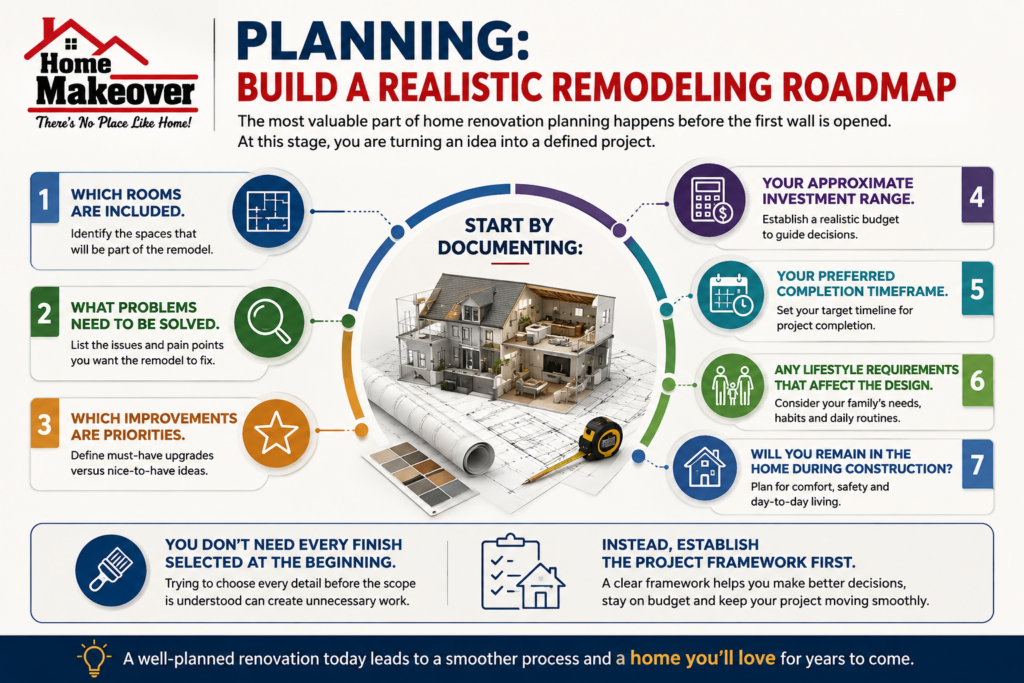
Planning: Build a Realistic Remodeling Roadmap

The most valuable part of home renovation planning happens before the first wall is opened.

At this stage, you are turning an idea into a defined project.

Start by documenting:

  1. Which rooms are included.
  2. What problems need to be solved.
  3. Which improvements are priorities.
  4. Your approximate investment range.
  5. Your preferred completion timeframe.
  6. Any lifestyle requirements that affect the design.
  7. Whether you will remain in the home during construction.

You do not need every finish selected at the beginning. In fact, trying to choose every detail before the scope is understood can create unnecessary work.

Instead, establish the project framework first.

Realistic Remodeling Roadmap

Create a Scope Before Creating a Shopping List

A remodeling scope should describe the work itself rather than simply naming products.

For example, “new kitchen” is vague.

A stronger scope might include:

  • Reconfigure kitchen layout.
  • Remove selected non-load-bearing walls.
  • Add or relocate electrical outlets.
  • Improve task lighting.
  • Replace cabinets and countertops.
  • Upgrade flooring.
  • Update plumbing connections.
  • Add storage where practical.
  • Repair or replace affected drywall and trim.

This gives the contractor and homeowner something concrete to discuss.

It also makes estimates easier to compare because you can determine whether different contractors are actually pricing the same work.

Consultation: What to Expect From a Professional Remodeling Consultation

A remodeling consultation should be more than a sales conversation.

It should be an opportunity to evaluate the property, discuss your goals and identify practical constraints that may affect the project.

During a productive remodeling consultation, expect questions about:

  • How you currently use the space.
  • What frustrates you about it.
  • How many people use the room.
  • Whether your needs may change.
  • Your preferred design direction.
  • Your budget expectations.
  • Your desired timeline.
  • Existing problems you already know about.

A good professional should also look beyond appearances.

Depending on the project, the discussion may involve structural conditions, electrical capacity, plumbing locations, ventilation, moisture, insulation, windows, roofing interfaces or other existing components.

A Real-World Example

Imagine a homeowner wants to remove a wall between a kitchen and dining room to create a more open layout.

The visual idea may be straightforward, but the wall could contain electrical wiring, plumbing or structural support.

A qualified remodeling team should identify those possibilities early rather than treating demolition as a surprise discovery.

That is one of the practical benefits of professional consultation: the earlier potential complications are identified, the more options you usually have for addressing them.

Contractor: Choosing the Right Remodeling Professional

Choosing a contractor is one of the highest-impact decisions in a renovation.

Price matters, but it should not be the only comparison point.

When evaluating a contractor for home remodeling services in Louisville, look at the overall picture:

  • Relevant experience with projects similar to yours.
  • Clear communication.
  • A detailed written scope.
  • Transparent pricing and allowances.
  • Evidence of proper licensing or registration where applicable.
  • Insurance coverage.
  • References or examples of completed work.
  • A defined process for changes.
  • Realistic scheduling.
  • Subcontractor and supplier coordination.
  • A clear approach to project cleanup and completion.

The right contractor should be able to explain not only what will be done, but also how the work will be coordinated.

Ask What Happens When Something Changes

Every substantial remodeling project involves decisions and, sometimes, unforeseen conditions.

Ask prospective contractors:

  • How are change orders handled?
  • Who approves additional work?
  • How are material substitutions communicated?
  • What happens if a selected product is delayed?
  • Who coordinates inspections?
  • How will schedule changes be communicated?
  • Who is responsible for coordinating subcontractors?

The answers can tell you a great deal about how the project will operate once construction begins.

Renovation Phases: Understanding What Happens After the Contract

A typical renovation moves through several overlapping phases. The exact sequence varies depending on the home’s condition and project scope, but understanding the basic structure helps homeowners know what to expect.

Phase 1: Discovery and Assessment

The project begins with understanding the existing home.

This may include reviewing the layout, measuring spaces, discussing goals and identifying visible or potential issues.

For older homes, additional investigation may be particularly important because previous renovations can create hidden conditions that are not obvious from the finished surfaces.

Phase 2: Design and Scope Development

The project is translated into plans, specifications and selections.

Depending on the project, this may include:

  • Floor plans.
  • Cabinet layouts.
  • Lighting plans.
  • Material selections.
  • Fixture specifications.
  • Finish schedules.
  • Structural details.
  • Mechanical considerations.

The more clearly these elements are defined before construction, the fewer major decisions need to be made while crews are working.

Phase 3: Permits and Pre-Construction

Projects requiring permits must follow the applicable local requirements.

The exact permitting process depends on the work and jurisdiction. Structural alterations, electrical work, plumbing modifications and additions can involve different requirements.

Your remodeling team should clarify which approvals are required and who is responsible for obtaining them.

This phase is also where material orders, subcontractor scheduling and site preparation become important.

Phase 4: Demolition and Preparation

Demolition is not simply “tear everything out.”

Careful demolition protects components that are staying and can reveal conditions behind walls, ceilings and floors.

For example, removing an old bathroom may reveal damaged subflooring or outdated plumbing. Discovering that condition is not necessarily evidence that the project was poorly planned; some conditions cannot be confirmed until concealed areas become accessible.

What matters is having a clear process for documenting and addressing them.

Phase 5: Rough Construction

This is where much of the work that eventually becomes invisible takes place.

Depending on the project, rough construction can include:

  • Framing.
  • Plumbing.
  • Electrical.
  • HVAC modifications.
  • Insulation.
  • Structural work.

Inspections may occur at appropriate points before walls are closed.

Phase 6: Installation and Finishes

Once the underlying work is complete, the project begins to look like the home you envisioned.

Cabinets, countertops, flooring, tile, fixtures, trim, paint, lighting and other finish elements are installed.

This is also where prior planning pays off. If selections were finalized early and materials arrived on schedule, the finishing phase can move much more efficiently.

Timeline: How Long Does a Home Renovation Take?

There is no single remodeling timeline that applies to every house.

A cosmetic update may take considerably less time than a whole-home renovation involving structural changes, multiple rooms, extensive mechanical work or custom materials.

A project timeline can be affected by:

  • Project size.
  • Design complexity.
  • Permit requirements.
  • Structural discoveries.
  • Material availability.
  • Custom fabrication.
  • Subcontractor availability.
  • Inspection scheduling.
  • Homeowner decisions.
  • Change orders.
  • Weather for exterior work.

For this reason, a responsible contractor should provide a realistic schedule rather than promising an unrealistically short completion date.

Why Material Decisions Can Affect the Schedule

Consider a kitchen renovation where cabinets are custom-built.

If cabinet dimensions affect countertop measurements, and countertop fabrication depends on cabinet installation, a delay in the cabinets can affect multiple downstream activities.

This is why contractor coordination matters.

A remodeling project is a sequence of dependencies. One delayed activity can sometimes affect several others.

Contractor Coordination: Keeping the Project Moving

A homeowner may see different crews arrive throughout a renovation, but those crews are part of a larger sequence.

Framers may need to complete their work before electricians and plumbers can finish rough-ins. Drywall may depend on inspections. Cabinets may need to be installed before countertops can be templated.

Effective contractor coordination keeps these dependencies organized.

Home Makeover Pro, for example, can serve as the central point of coordination for homeowners who want one team managing the moving pieces of their remodeling project rather than trying to organize every trade independently.

The important principle is not simply having multiple professionals involved. It is having someone responsible for making sure their work fits together.

Practical Home Improvement Project Tips for Louisville and Southern Indiana

Local homes can vary considerably in age, construction and previous renovation history. That makes property-specific assessment important.

If you are considering a home improvement project, keep these practical points in mind.

1. Do Not Assume the Existing Layout Can Stay Untouched

Sometimes a small change to one room makes sense only if another space is adjusted.

For instance, moving a kitchen sink may affect plumbing. Removing a wall may affect electrical routing. Expanding a bathroom may reduce useful space elsewhere.

Think about the home as a connected system.

2. Keep a Contingency Fund

Even a carefully planned renovation can uncover hidden conditions.

A contingency is not an invitation to spend more. It is protection against circumstances that could not reasonably be confirmed before construction.

Your contractor can help identify where uncertainty is highest.

3. Finalize Major Selections Early

Cabinetry, windows, specialty fixtures and custom materials can have longer lead times than standard items.

Ask which selections are schedule-critical and make those decisions first.

4. Plan for Daily Life During Construction

If you are staying in the home, determine how construction will affect:

  • Cooking.
  • Bathing.
  • Sleeping arrangements.
  • Children and pets.
  • Parking.
  • Access to the property.
  • Dust and noise.
  • Temporary storage.

A good renovation plan considers the people living in the house, not just the construction drawings.

Common Renovation Mistakes Homeowners Should Avoid

Mistake 1: Choosing a Contractor Based Only on the Lowest Price

A lower estimate may reflect a narrower scope, different material allowances or omitted work.

Compare what each proposal actually includes.

Mistake 2: Changing the Scope Repeatedly

Some changes are unavoidable. Others happen because decisions were not made before construction.

Repeated changes can increase costs and extend the schedule.

Mistake 3: Underestimating Existing-Home Conditions

Renovation differs from new construction because the contractor is working with something that already exists.

Walls may not be perfectly straight. Previous work may not meet current expectations. Plumbing and electrical systems may have limitations.

Expect some investigation.

Mistake 4: Treating the Timeline as a Guarantee

A schedule is a management tool, not a promise that nothing will ever change.

The better approach is to understand the project’s critical path and the factors that could move completion.

Mistake 5: Focusing Only on Appearance

A successful renovation should look good, but it should also function well.

Storage, lighting, circulation, maintenance, durability and accessibility can matter just as much as finishes.

Expert Advice: Make Decisions in the Right Order

One of the most useful principles in home renovation planning is to make decisions according to their impact on the project.

A practical order is:

Function → Layout → Structural considerations → Mechanical systems → Major materials → Fixtures → Finishes → Decorative details

For example, there is little value in spending hours choosing a backsplash before you know where the cabinets, appliances and electrical outlets will be located.

Likewise, choosing paint colors before confirming flooring and cabinetry can create unnecessary rework.

The earlier a decision affects the construction sequence, the earlier it should generally be resolved.

When to Reconsider the Original Plan

A good remodeling plan is not rigid.

Suppose demolition reveals significant moisture damage beneath an existing floor. You may have to decide whether to repair it immediately, modify the design or adjust another part of the budget.

That is where priorities become useful.

Return to the original question: What are we trying to accomplish with this project?

If the goal is to create a durable, functional kitchen for the next decade, addressing an underlying moisture issue may be more valuable than upgrading a decorative feature.

Good remodeling decisions are not always about getting everything you initially imagined. They are about protecting the improvements that matter most.

The Final Walkthrough and Project Completion

A renovation is not finished simply because the crews have left.

The final stage should include a careful walkthrough to identify incomplete or deficient items and confirm that the project matches the agreed scope.

Depending on the project, review:

  • Doors and drawers.
  • Cabinet alignment.
  • Fixtures.
  • Flooring.
  • Tile work.
  • Paint and trim.
  • Lighting.
  • Outlets and switches.
  • Plumbing fixtures.
  • Appliances.
  • Hardware.
  • Caulking and finish details.
  • Cleanup.
  • Outstanding documentation or warranties.

A professional final walkthrough gives both the homeowner and remodeling team an opportunity to address details before the project is considered complete.

Home Remodeling Should Be a Process, Not a Guess

The best remodeling experiences are rarely the result of luck.

They come from thoughtful home renovation planning, realistic budgeting, clear communication and disciplined execution.

Whether you are considering home remodeling in Louisville, a smaller renovation or residential home remodeling in Southern Indiana, the same principle applies: understand the goal first, define the scope, choose the right contractor, plan the sequence and communicate throughout the project.

Home Makeover Pro can help homeowners approach that process with greater clarity, from the initial remodeling consultation through project coordination and completion.

The goal is not simply to create a newer-looking house. It is to create a home that works better for the people who live there.

Final Takeaway

A successful remodel begins long before construction starts.

The strongest projects are built on clear goals, realistic home renovation planning, thoughtful design, qualified contractor coordination and an understanding of the major renovation phases.

If you are exploring home remodeling services in Louisville or planning residential home remodeling in Southern Indiana, take the time to build the roadmap before rushing into construction. The more clearly you understand the process, the easier it becomes to make informed decisions when the project is underway.

A well-planned renovation does more than update a house. It creates a space that better supports the way you live today—and the way you expect to live in the years ahead.

Frequently Asked Questions

1. How should I start planning a home remodel in Louisville?

Start by identifying the specific problems you want the renovation to solve rather than immediately choosing finishes or products. Document the rooms involved, your must-have improvements, your preferred timeframe and your approximate investment range.

Then schedule a professional remodeling consultation. A contractor can evaluate the existing property, discuss feasibility and help turn your ideas into a defined scope. For larger projects, early planning can also identify structural, plumbing, electrical or permitting considerations before construction begins.

2. How long does a typical home remodeling project take?

There is no universal timeline. A limited renovation may be relatively short, while a whole-home project can take considerably longer.

The remodeling timeline depends on project size, design complexity, permits, material lead times, inspections, subcontractor availability and whether unexpected conditions are discovered.

Ask your contractor for a project-specific schedule and identify which activities are on the critical path. This provides a much more useful expectation than relying on a generic “average” renovation time.

3. Should I stay in my house during a renovation?

It depends on the size and location of the project.

Staying home may be practical during an isolated room renovation, but a major kitchen remodel, whole-home renovation or project involving significant dust, noise, utility interruptions or restricted access can be much more disruptive.

Before construction begins, discuss temporary kitchen or bathroom arrangements, work zones, access routes, pets, children, parking and expected utility interruptions. A good contractor should help you understand the practical impact on daily life.

4. How can I avoid unexpected remodeling costs?

You cannot eliminate every possibility, particularly when renovating an existing home, but you can reduce surprises.

Start with a detailed scope and have the contractor explain allowances, exclusions and assumptions in the estimate. Ask how change orders are handled and maintain a reasonable contingency for unknown conditions.

It is also helpful to complete major design decisions before construction begins. Late changes to layouts, cabinetry, plumbing or electrical work can be significantly more disruptive than changing a decorative finish.

5. What should I look for when choosing a home remodeling contractor?

Look beyond the lowest bid. Choose a contractor who can demonstrate relevant experience, provide a clear written scope, communicate effectively and explain how the project will be scheduled and coordinated.

Ask about insurance, references, permits, subcontractor management, change orders, material procurement and the final walkthrough process.

Most importantly, pay attention to how the contractor communicates during the initial consultation. A remodeling professional who listens carefully, identifies potential problems and explains trade-offs clearly is often better positioned to manage the complexities that arise during construction.

How to Choose the Best Home Remodeling Contractor in Louisville & Southern Indiana

A successful home renovation starts long before demolition begins. It starts with choosing the right professional to guide the project from planning to completion. Whether you’re updating a dated kitchen, expanding your living space, renovating a bathroom, or modernising your entire property, the contractor you hire will significantly influence the final outcome. Many homeowners searching for home remodeling contractors in Indiana quickly discover that selecting the right company involves much more than comparing quotes. This guide explains what to look for in a reliable Home Remodeling Contractor, helping you make a confident, informed decision for your next project.

Why Choosing the Right Contractor Matters

Home remodeling is one of the largest investments many homeowners make after purchasing their property. Unlike replacing furniture or repainting a room, structural renovations often involve multiple trades, permits, inspections, budgeting, and detailed project management.

The right contractor doesn’t simply complete construction work—they coordinate schedules, solve unexpected problems, communicate clearly, and protect your investment throughout the entire process.

In Louisville and Southern Indiana, every neighbourhood presents unique remodeling considerations. Older homes may require electrical upgrades, plumbing replacements, or structural reinforcement before cosmetic improvements begin. Newer homes often focus on layout improvements, modern finishes, or energy efficiency upgrades.

Understanding these differences is why selecting an experienced remodeling professional is so important.

Look Beyond the Lowest Quote from a Contractor

Price often becomes the first comparison homeowners make, but it should never be the only deciding factor.

An unusually low estimate may not include everything your project requires. Missing details can result in unexpected changes later, while overly simplified proposals may overlook important preparation work.

Instead of asking:

“Who is cheapest?”

Ask:

  • What work is included?
  • Are permits included?
  • Is demolition covered?
  • Will materials be supplied?
  • How are unexpected issues handled?
  • Is project management included?

Transparent quotations usually indicate organised contractors who understand project planning rather than simply competing on price.

Verify Contractor Credentials Before Signing Anything

One of the easiest ways to avoid future problems is verifying contractor credentials before work begins.

Professional remodeling companies should willingly discuss their qualifications and explain how they manage projects from beginning to end.

Important areas to confirm include:

Licensing

Understand local licensing requirements applicable to your project.

Insurance

Insurance protects both homeowners and contractors if accidents occur during construction.

Permits

Many remodeling projects require permits before work begins. Reliable contractors understand local building regulations and explain when approvals are necessary.

Written Contracts

Everything discussed should appear in writing, including timelines, payment schedules, project scope, responsibilities, and procedures for changes.

Experienced homeowners know documentation creates clarity—not distrust.

Experience Makes a Difference in Remodeling Projects

Every renovation uncovers surprises.

Walls may conceal outdated wiring.

Floors might reveal water damage.

Older framing may require reinforcement.

Contractors with extensive remodeling experience remain calm because they’ve solved similar problems before.

Experience allows professionals to:

  • Recommend practical alternatives.
  • Keep projects moving.
  • Reduce unnecessary delays.
  • Protect existing finishes.
  • Coordinate multiple trades efficiently.

This experience becomes especially valuable during larger renovations involving kitchens, bathrooms, room additions, or whole-home transformations.

Real-World Example

Imagine two homeowners renovating similar kitchens.

The first hires based solely on price.

The second selects a contractor with years of renovation experience and detailed planning procedures.

Halfway through demolition, hidden plumbing issues appear.

The experienced contractor quickly adjusts the plan, communicates clearly, updates the schedule, and resolves the issue without unnecessary disruption.

The inexperienced contractor struggles with coordination, causing delays and confusion.

The difference isn’t simply technical skill—it’s project management developed through years of practical experience.

Review the Company’s Portfolio Carefully

A professional portfolio tells a story beyond attractive photographs.

Instead of looking only at finished kitchens or bathrooms, pay attention to consistency.

Ask yourself:

  • Do projects reflect different home styles?
  • Are finishes completed neatly?
  • Does the workmanship appear consistent?
  • Are details well executed?
  • Is there evidence of structural work, not only decorating?

An experienced Home Remodeling Contractor should confidently explain previous projects and discuss the challenges each renovation presented.

A strong portfolio demonstrates versatility rather than repeating identical designs.

Reviews Reveal More Than Star Ratings

Online Reviews provide valuable insight when interpreted carefully.

Rather than focusing exclusively on overall ratings, read detailed customer feedback.

Look for comments discussing:

  • Communication
  • Project organisation
  • Reliability
  • Cleanliness
  • Timeliness
  • Problem-solving
  • Respect for homeowners
  • Quality after completion

Pay attention to how contractors respond when minor issues arise.

Professional communication often reflects professional project management.

Home Remodeling Requires Excellent Communication

One of the biggest causes of renovation frustration isn’t poor workmanship.

It’s poor communication.

Reliable contractors explain:

  • What happens next
  • Expected timelines
  • Material availability
  • Inspection requirements
  • Unexpected discoveries
  • Weather-related delays
  • Variation procedures

Regular updates reduce uncertainty and help homeowners feel involved throughout the project.

Good communication builds trust long before the final walkthrough.

Understand Insurance and Liability

Insurance is often overlooked until something unexpected happens.

Professional contractors should carry appropriate insurance coverage and willingly explain how homeowners are protected during construction.

Insurance may cover situations involving:

  • Property damage
  • Workplace accidents
  • Contractor liability
  • Unexpected construction incidents

Choosing insured professionals provides additional confidence throughout the remodeling process.

Why Local Remodeling Knowledge Matters

Every region has unique building requirements.

Working with professionals familiar with Louisville and Southern Indiana offers several advantages.

A local remodeling company understands:

  • Local building regulations
  • Permit procedures
  • Weather considerations
  • Common construction methods
  • Typical foundation styles
  • Regional material availability

This local knowledge often prevents delays while improving planning accuracy.

Homeowners considering home remodeling Louisville frequently benefit from contractors who understand neighbourhood-specific construction challenges and design preferences.

Questions Every Homeowner Should Ask

Before making a final decision, prepare thoughtful questions.

Examples include:

How do you manage project timelines?

Understanding scheduling helps establish realistic expectations.

Who supervises work each day?

Knowing the main contact improves communication.

How are changes handled?

Most remodeling projects evolve.

Understanding variation procedures avoids misunderstandings.

What happens if unexpected structural issues appear?

Experienced contractors should explain their process clearly.

Can I see similar completed projects?

Previous work often demonstrates capability more effectively than marketing materials.

Common Mistakes Homeowners Should Avoid

Choosing a remodeling contractor becomes much easier when you recognise common mistakes.

Avoid:

  • Selecting solely on price.
  • Accepting verbal agreements.
  • Ignoring insurance documentation.
  • Failing to review previous projects.
  • Rushing major decisions.
  • Comparing estimates without reviewing scope.
  • Assuming all contractors offer identical services.
  • Overlooking communication quality during early meetings.

Many renovation problems begin before construction starts—not during it.

Expert Tips for Choosing the Right Remodeling Partner

Experienced industry professionals often recommend approaching contractor selection like a long-term partnership rather than a simple purchase.

Helpful strategies include:

  • Meet more than one contractor.
  • Compare project planning, not just pricing.
  • Ask detailed questions.
  • Review portfolios carefully.
  • Read multiple customer reviews.
  • Confirm licensing and insurance.
  • Request realistic timelines.
  • Prioritise communication and transparency.

These simple steps dramatically improve the likelihood of a positive remodeling experience.

Why Trust Matters Throughout Every Remodeling Project

Trust develops through consistent actions rather than promises.

Reliable contractors arrive prepared, communicate honestly, manage expectations realistically, and explain recommendations clearly.

Whether renovating one room or an entire property, homeowners should feel comfortable asking questions and discussing concerns throughout the process.

Professionals who encourage informed decisions usually deliver smoother remodeling experiences because both parties understand expectations from the beginning.

Many homeowners researching home improvement contractors discover that professionalism extends beyond craftsmanship. Organisation, communication, planning, and accountability are equally important.

Conclusion

Choosing among home remodeling contractors Indiana involves much more than comparing estimates or browsing photographs online. Experience, credentials, communication, insurance, local knowledge, and project management all contribute to successful renovations that add long-term value to your home.

A knowledgeable Home Remodeling Contractor focuses on understanding your goals, identifying potential challenges early, and providing honest guidance throughout every stage of the project. That collaborative approach helps minimise stress while delivering results that meet both functional needs and design expectations.

For homeowners planning renovations in Louisville or Southern Indiana, working with experienced professionals like Home Makeover Pro offers valuable insight throughout the planning process. Rather than rushing decisions, Home Makeover Pro encourages homeowners to ask questions, review credentials, and fully understand the renovation journey before construction begins. By prioritising transparency, workmanship, and communication, Home Makeover Pro helps homeowners approach remodeling projects with greater confidence and realistic expectations.

Frequently Asked Questions

1. How do I know if a remodeling contractor is genuinely experienced?

Look beyond the number of years in business. Ask about similar completed projects, request a portfolio, read detailed customer reviews, and discuss how the contractor handles unexpected issues during construction. Experienced contractors provide practical examples and explain their process clearly rather than making vague promises.

2. Why are permits important for home remodeling projects?

Permits help ensure renovations comply with local building regulations and safety standards. Depending on the scope of work, projects involving structural changes, electrical systems, plumbing, or additions may require approvals before construction begins. A knowledgeable contractor will explain which permits apply and how the process works.

3. Should I always choose the contractor with the lowest quote?

Not necessarily. A lower estimate may exclude important items such as demolition, permits, project management, or material allowances. Compare the full scope of work, communication quality, experience, and included services before making your decision rather than focusing only on price.

4. What should I look for when reviewing a contractor’s portfolio?

A strong portfolio should demonstrate consistent workmanship across different project types and home styles. Look for quality finishes, attention to detail, functional layouts, and projects similar to your own. Asking about the challenges behind each project can also reveal the contractor’s problem-solving ability.

5. How can I prepare before meeting a remodeling contractor?

Start by identifying your renovation goals, gathering inspiration images, establishing priorities, and listing any concerns about your existing home. Preparing questions about timelines, permits, communication, materials, and project management will help you compare contractors more effectively and make a well-informed decision.

Expanding Kitchen Area With Home Additions Lousville

It’s almost a trend to this day. Home additions are increasingly becoming a hot choice for people who are planning to expand their kitchen areas. It’s all about letting the space breathe a new life. Whether you’re looking to increase your square footage, add specific features like granite countertops or install a stylish new backsplash, home additions Louisville offer numerous benefits. Home maker professionals work with a team of experts who are knowledgeable about these kinds of designs. They can help you create the kitchen of your dreams. In this article, we’ll explore the advantages of home additions and why choosing our team ensures a seamless and successful renovation.

Tailored to Your Needs

One of the main benefits of home additions Louisville is the ability to design a custom kitchen layout that suits your specific needs and lifestyle. Perhaps you envision a spacious island for food preparation and casual dining, or maybe you need a dedicated pantry for additional storage. High-quality kitchen cabinets can provide ample storage space while adding a touch of sophistication to your new kitchen. Similarly, granite countertops offer durability and elegance, making them a popular choice for busy kitchens. These materials not only enhance the functionality of your kitchen but also elevate its aesthetic appeal. Services for home remodeling Louisville will allow you to incorporate these elements, creating a kitchen that is both functional and personalized.

Boost Your Home’s Value

Beyond improving functionality, a home addition can significantly increase the value of your property. An updated kitchen with modern amenities and stylish finishes can make your home more attractive to potential buyers. By investing in quality materials, you can command a higher selling price when it’s time to list your home.

A skilled roofing contractor Louisville can guide you through the process, helping you make strategic choices that maximize your return on investment. With our expertise, you can enhance the overall appeal of your property and ensure that your renovation adds lasting value.

Quality Work from Start to Finish

When planning a home addition, it’s essential to work with a reputable and experienced contractor who can bring your vision to life. Professionals with knowledge of home additions Louisville have extensive experience in kitchen renovations. They are backed by a portfolio of successful projects. As a result, they prioritize the importance of delivering quality work on time and within budget.

From the initial design phase to the final touches, our contractors will work closely with you to ensure that every detail aligns with your vision. Whether you’re expanding your existing kitchen or creating an entirely new space, we are committed to providing a seamless and stress-free renovation experience.

Your Trusted Partner For All Types of Home Additions

A home addition is a valuable investment that can transform your Kentucky kitchen into a functional and stylish space. By incorporating features like custom kitchen cabinets and granite countertops, you can enhance both the aesthetics and functionality of your kitchen. New home construction in Louisville must be done with careful thoughts as your investments matter. Choose your contractors carefully and plan accordingly.

With the help of our trusted home addition contractors, you can confidently navigate the renovation process and achieve the kitchen you’ve always dreamed of. Whether you’re looking to expand your kitchen or add new elements to improve its look and feel, we’re here to help every step of the way.